
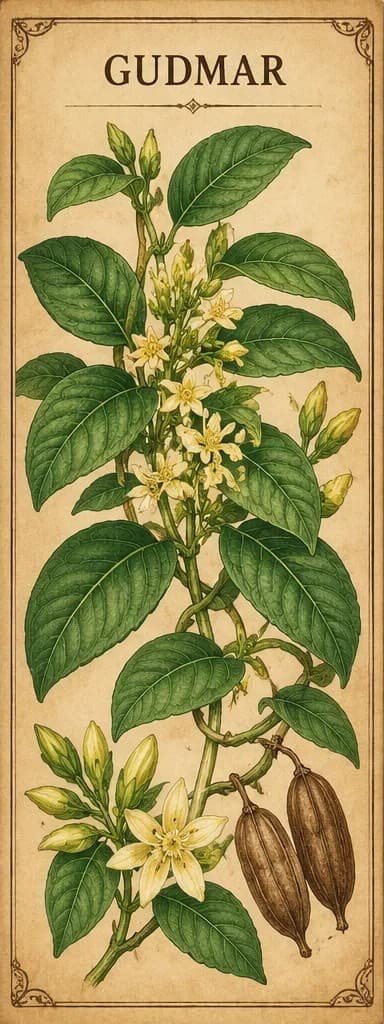
Gudmar
Gymnema sylvestre
Gurmar, the "sugar destroyer", an Ayurvedic climbing plant used for diabetes. It lowered blood sugar in animal studies, with mixed results in people.
Safety at a glance
- PregnancyNothing recorded
- BreastfeedingNothing recorded
- MedicinesNothing recorded
- Who should avoid itNothing recorded
- AllergiesNothing recorded
- ToxicityNothing recorded
Tap a box to read the safety notes below. “Nothing recorded” means our sources don't cover it, not that it's safe.
What is Gudmar?
- Plant family
- Apocynaceae, the dogbane and milkweed family
- Parts used
- The leaves
- Where it grows
- India, tropical Africa and Australia
- Genus
- Gymnema
- Species
- sylvestre
Also called
Gurmar, Gymnema
Traditional names
Madhunashini, Meshashringi
Traditionally used for
- Diabetes (traditional)
Traditionally described as
- Can block the taste of sweetness
Health topics
Where Gudmar appears in symptom search, and why. Being listed doesn't mean it's a proven treatment.
- High Blood Sugar
Used in Ayurveda for diabetes; lowered blood sugar in animal studies, with mixed results in people.
Traditions that use it
- Ayurveda
Called gurmar, "sugar destroyer"; described in the Charaka and Sushruta Samhitas for diabetes.
Natural compounds
What does the research say?
Traditional use
These are traditional uses, not proven treatments.
Gudmar's Hindi name, gurmar, means "sugar destroyer", because it can block the taste of sweetness. It is described in the classic Ayurvedic texts and widely used in Ayurveda for diabetes, and also for digestive, liver, breathing, heart, skin and eye problems.[1]Study
Laboratory & animal research
Lab and animal results show what might be worth studying in people. They don't show that the herb has these effects in humans.
In diabetic rats and rabbits, leaf extracts lowered blood sugar and raised insulin, and in rabbits it added to the effect of the diabetes drug metformin. Researchers think it helps regrow insulin-making cells in the pancreas and slows sugar absorption from the gut.[2]Study
Research in people
Studies in people with diabetes found benefits, but results vary. In one study of people with metabolic syndrome, it didn't change how well the body used insulin, possibly because most of them had normal blood sugar to begin with.[1]Study
In short
In rabbits it added to the blood-sugar-lowering effect of metformin.
Sources
- [1] Gymnema sylvestre as a Multi-Target Antidiabetic Agent: Mechanistic Insights and Metabolic Regulation · DOI: 10.3390/ijms27125609Peer-reviewed study
- [2] Herbal Medicines in the Management of Diabetes Mellitus: Plants, Bioactive Compounds, and Mechanisms of Action · DOI: 10.3390/biom15121674Peer-reviewed study
This information is educational and traditional in nature, and is not a substitute for professional medical advice. Unfamiliar word? See what these words mean.