
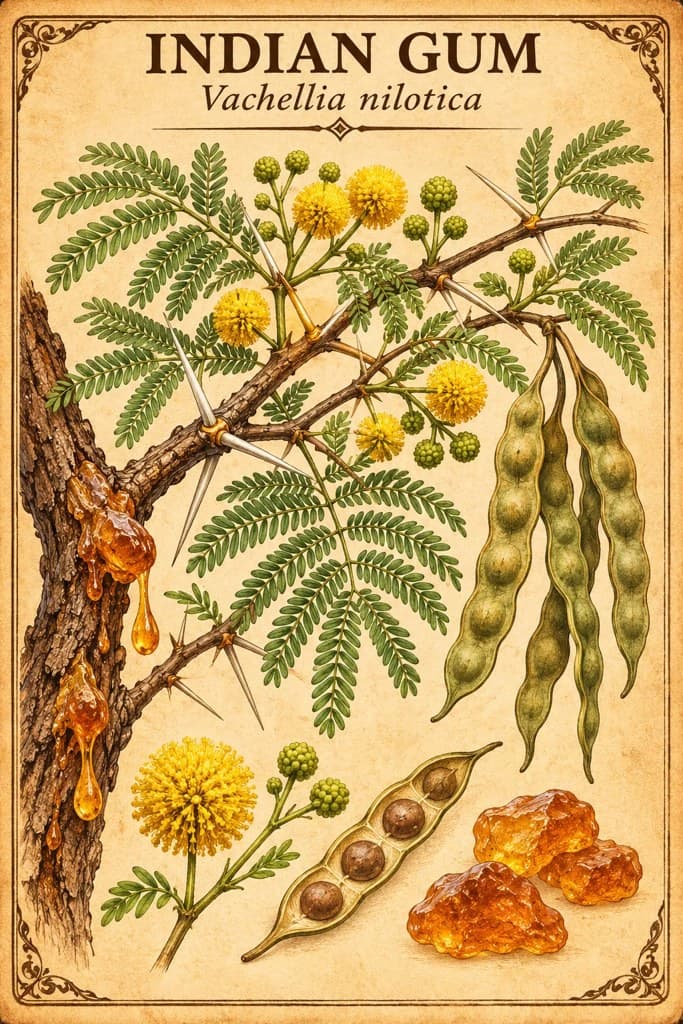
Indian Gum
Vachellia nilotica
Babul, a thorny acacia whose gum, bark and pods are used in traditional medicine, and the most widely used acacia for treating livestock in Africa.
Safety at a glance
- PregnancyNothing recorded
- BreastfeedingNothing recorded
- MedicinesNothing recorded
- Who should avoid itNothing recorded
- AllergiesNothing recorded
- Toxicity1 note →
Tap a box to read the safety notes below. “Nothing recorded” means our sources don't cover it, not that it's safe.
What is Indian Gum?
- Plant family
- Fabaceae, the pea and bean family
- Parts used
- The gum, bark, pods and fruit
- Where it grows
- Africa, the Middle East and the Indian subcontinent
- Genus
- Vachellia
- Species
- nilotica
Also called
Babul
Older scientific names
Acacia nilotica
Traditionally used for
- Traditional medicine
- Livestock health
Traditionally described as
- Rich in tannins; gum used as a medicine binder
Traditions that use it
- African Traditional Medicine
The most widely used acacia for treating livestock in Africa.
Safety
Toxicity testing
In male rats given babul for 16 weeks, sperm count and movement fell and testosterone dropped. Sperm didn't recover after it was stopped.[1]Study
What does the research say?
Traditional use
These are traditional uses, not proven treatments.
The fruit, bark and pods of babul have long been used in traditional medicine. They are rich in tannins.[2]Study
In Africa, babul is the most widely used acacia for treating livestock, against infections, inflammation and parasites.[3]Review or trial
Laboratory & animal research
Lab and animal results show what might be worth studying in people. They don't show that the herb has these effects in humans.
In short
Lowered sperm count and testosterone in male rats.
Sources
- [1] The Anti-fertility Effects of Acacia nilotica in Male Wistar RatsPeer-reviewed study
- [2] Selective anticancer activity of Vachellia nilotica fruit extract: integrated phytochemistry with antioxidant, antimicrobial, and cancer cell targeting · DOI: 10.3389/fnut.2026.1799072Peer-reviewed study
- [3] Ethnoveterinary Potential of Acacia (Vachellia and Senegalia) Species for Managing Livestock Health in Africa: From Traditional Uses to Therapeutic Applications · DOI: 10.3390/plants14193107Review or clinical trial
- [4] Formulation and evaluation of microsphere of antiulcer drug using Acacia nilotica gumPeer-reviewed study
This information is educational and traditional in nature, and is not a substitute for professional medical advice. Unfamiliar word? See what these words mean.