
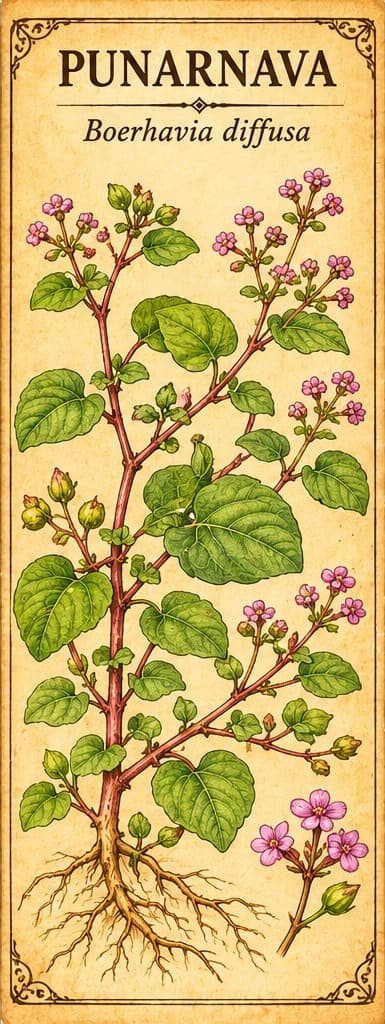
Punarnava
Boerhavia diffusa
A creeping Ayurvedic rejuvenating herb used for urinary, liver and digestive problems. Its root protected the kidneys in rats.
Safety at a glance
- PregnancyNothing recorded
- BreastfeedingNothing recorded
- MedicinesNothing recorded
- Who should avoid itNothing recorded
- AllergiesNothing recorded
- ToxicityNothing recorded
Tap a box to read the safety notes below. “Nothing recorded” means our sources don't cover it, not that it's safe.
What is Punarnava?
- Plant family
- Nyctaginaceae, the four o'clock family
- Parts used
- The root and whole plant
- Where it grows
- Tropical and subtropical regions worldwide
- Genus
- Boerhavia
- Species
- diffusa
Traditionally used for
- Urinary problems
- Liver
- Jaundice (traditional)
Traditionally described as
- Ayurvedic rasayana herb
Traditions that use it
- Ayurveda
A rasayana (rejuvenating) herb in Ayurveda.
What does the research say?
Traditional use
These are traditional uses, not proven treatments.
In Ayurveda, punarnava is a rasayana, a herb believed to slow aging and strengthen life. It is traditionally used for problems of the urinary system, liver and jaundice, digestion, breathing, the heart and the reproductive system.[1]Study
Laboratory & animal research
Lab and animal results show what might be worth studying in people. They don't show that the herb has these effects in humans.
In rats given a cancer drug that damages the kidneys, punarnava root extract protected the kidneys, improving kidney test results and lowering signs of inflammation.[2]Study
In short
No human or safety studies were found.
Sources
- [1] Phytochemical, therapeutic, and ethnopharmacological overview for a traditionally important herb: Boerhavia diffusa Linn. · DOI: 10.1155/2014/808302Peer-reviewed study
- [2] Protective role of Boerhavia diffusa root extract in methotrexate-induced renal injury: evidence from oxidative stress, molecular, and immunohistochemical markers · DOI: 10.1186/s12906-026-05389-0Peer-reviewed study
This information is educational and traditional in nature, and is not a substitute for professional medical advice. Unfamiliar word? See what these words mean.