
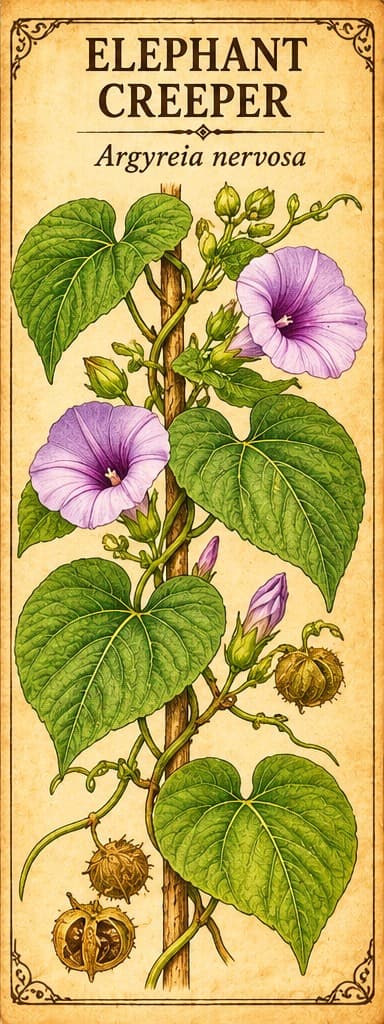
Elephant Creeper
Argyreia nervosa
Hawaiian baby woodrose, a climbing vine whose leaves helped wounds heal in rats and whose seeds contain the hallucinogen LSA.
Safety at a glance
- PregnancyNothing recorded
- BreastfeedingNothing recorded
- MedicinesNothing recorded
- Who should avoid itNothing recorded
- AllergiesNothing recorded
- Toxicity1 note →
Tap a box to read the safety notes below. “Nothing recorded” means our sources don't cover it, not that it's safe.
What is Elephant Creeper?
- Plant family
- Convolvulaceae, the morning glory family
- Parts used
- The leaves and roots (the seeds are hallucinogenic)
- Where it grows
- India; now grown in tropical regions
- Genus
- Argyreia
- Species
- nervosa
Also called
Hawaiian Baby Woodrose
Traditionally used for
- Wounds (traditional)
Traditionally described as
- Seeds contain LSA
Natural compounds
Safety
Toxicity testing
The seeds contain LSA, a hallucinogen. People who took them have had hallucinations, nausea and anxiety, and some had psychosis, high blood pressure or needed hospital care. The amount of LSA in seeds varies a lot, which makes the effects unpredictable.[1]Review or trial
What does the research say?
Traditional use
These are traditional uses, not proven treatments.
The seeds have been used in rituals and traditional medicine by Indigenous peoples. They are the main source of lysergic acid amide (LSA), a hallucinogen related to LSD.[1]Review or trial
Laboratory & animal research
Lab and animal results show what might be worth studying in people. They don't show that the herb has these effects in humans.
In normal and diabetic rats and mice, a leaf extract applied to wounds, or taken by mouth in diabetic animals, helped wounds heal faster.[2]Study
In short
The seeds are hallucinogenic and have caused psychosis and hospital visits.
Sources
- [1] Lysergic Acid Amide (LSA), an LSD Analog: Systematic Review of Pharmacological Effects, Adverse Outcomes, and Therapeutic Potentials · DOI: 10.3390/pharmacy13040098Review or clinical trial
- [2] Wound healing activity of Argyreia nervosa leaves extract · DOI: 10.4103/2229-516X.81978Peer-reviewed study
This information is educational and traditional in nature, and is not a substitute for professional medical advice. Unfamiliar word? See what these words mean.