
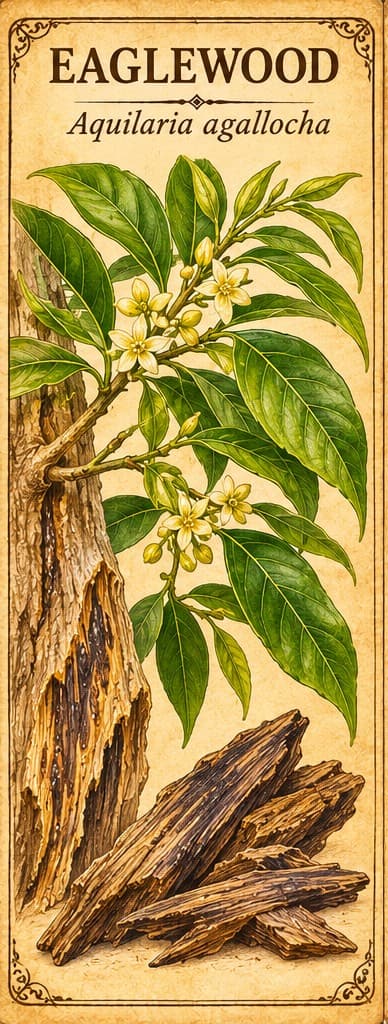
Eaglewood
Aquilaria malaccensis
Agarwood or oud, the fragrant resin-filled heartwood of an Asian tree, prized for incense, perfume and traditional medicine.
Safety at a glance
- PregnancyNothing recorded
- BreastfeedingNothing recorded
- MedicinesNothing recorded
- Who should avoid itNothing recorded
- AllergiesNothing recorded
- ToxicityNothing recorded
Tap a box to read the safety notes below. “Nothing recorded” means our sources don't cover it, not that it's safe.
What is Eaglewood?
- Plant family
- Thymelaeaceae, the daphne family
- Parts used
- The dark, fragrant resin-filled heartwood (agarwood)
- Where it grows
- South and Southeast Asia
- Genus
- Aquilaria
- Species
- malaccensis
Also called
Agarwood, Oud
Older scientific names
Aquilaria agallocha
Traditionally used for
- Incense
- Perfume
- Traditional medicine
Traditionally described as
- Fragrant resin
What does the research say?
Traditional use
These are traditional uses, not proven treatments.
Agarwood is a dark, fragrant resin that forms in the wood of Aquilaria trees after injury or infection. Known as agar in South Asia, oud in Arabic and jinkoh in Japanese, it has long been used in incense, perfume and traditional medicine.[1]Study
Laboratory & animal research
Lab and animal results show what might be worth studying in people. They don't show that the herb has these effects in humans.
Agarwood contains compounds that in lab studies acted against microbes, inflammation and cancer cells, and had calming effects. Overharvesting and illegal trade threaten wild trees, so it is increasingly grown on plantations.[1]Study
A 2024 chemical study found agarwood from Brunei and Vietnam is rich in sesquiterpenes linked to easing anxiety, while agarwood from Malaysia and Indonesia is richer in fragrance compounds. The anxiety link was predicted by computer, not tested in people.[2]Study
In short
No human or safety studies were found.
Sources
- [1] Agarwood in the Modern Era: Integrating Biotechnology and Pharmacology for Sustainable Use · DOI: 10.3390/ijms26178468Peer-reviewed study
- [2] Solid-Phase Microextraction/Gas Chromatography-Time-of-Flight Mass Spectrometry Approach Combined with Network Pharmacology Analysis to Evaluate the Quality of Agarwood from Different Regions against Anxiety Disorder · DOI: 10.3390/molecules29020468Peer-reviewed study
This information is educational and traditional in nature, and is not a substitute for professional medical advice. Unfamiliar word? See what these words mean.