
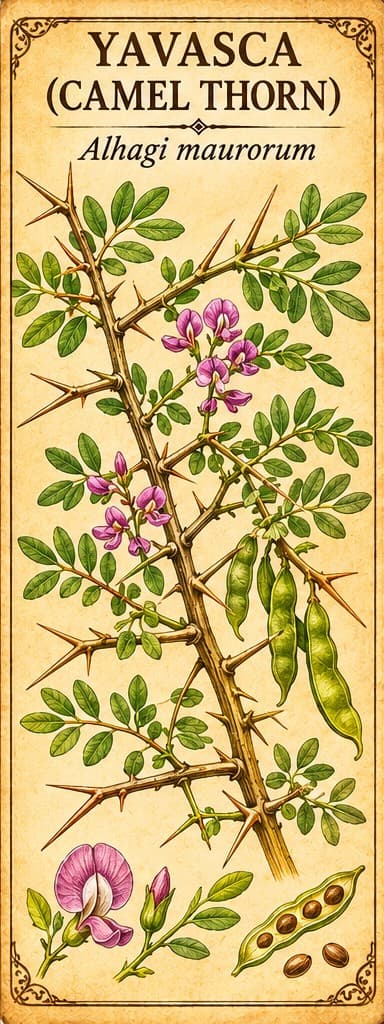
Yavasca
Alhagi maurorum
Camel thorn, a spiny desert shrub used in Iran for kidney stones. In a trial, its extract cleared stones as well as a standard drug.
Safety at a glance
- PregnancyNothing recorded
- BreastfeedingNothing recorded
- MedicinesNothing recorded
- Who should avoid itNothing recorded
- AllergiesNothing recorded
- ToxicityNothing recorded
Tap a box to read the safety notes below. “Nothing recorded” means our sources don't cover it, not that it's safe.
What is Yavasca?
- Plant family
- Fabaceae, the pea and bean family
- Parts used
- The above-ground parts
- Where it grows
- North Africa, the Middle East and Central Asia
- Genus
- Alhagi
- Species
- maurorum
Also called
Camel Thorn
Regional names
Kharshotor
Traditionally used for
- Kidney stones (traditional and trial)
Traditionally described as
- Spiny pea-family shrub
Health topics
Where Yavasca appears in symptom search, and why. Being listed doesn't mean it's a proven treatment.
- Kidney Stones
Traditionally used for kidney stones in Iran; in one trial its extract cleared stones as well as hydrochlorothiazide.
What does the research say?
Traditional use
These are traditional uses, not proven treatments.
In Shiraz, Iran, camel thorn (kharshotor) was the plant people mentioned most often for kidney stones, taken as a tea of the above-ground parts. It's also used for stomach upsets, ulcers, fever, headache, toothache, liver problems, urinary infections and high blood pressure.[1]Study
Research in people
In a randomized trial of 80 adults with 4 to 10 mm kidney or ureter stones, camel thorn extract capsules worked as well as the drug hydrochlorothiazide: stone size and number fell by up to 70% in both groups, with no serious side effects.[2]Study
In short
No serious side effects were seen in the trial.
Sources
- [1] Identification of medicinal plants for the treatment of kidney and urinary stones · DOI: 10.15171/jrip.2016.27Peer-reviewed study
- [2] Comparison of the Effect of Hydroalcholic Extract of Alhagi maurorum and Hydrochlorothiazide on Excretion of 4-10 mm Kidney and Ureteral Stones in Adults: A Randomized Prospective Study · DOI: 10.1155/2023/6624981Peer-reviewed study
This information is educational and traditional in nature, and is not a substitute for professional medical advice. Unfamiliar word? See what these words mean.