
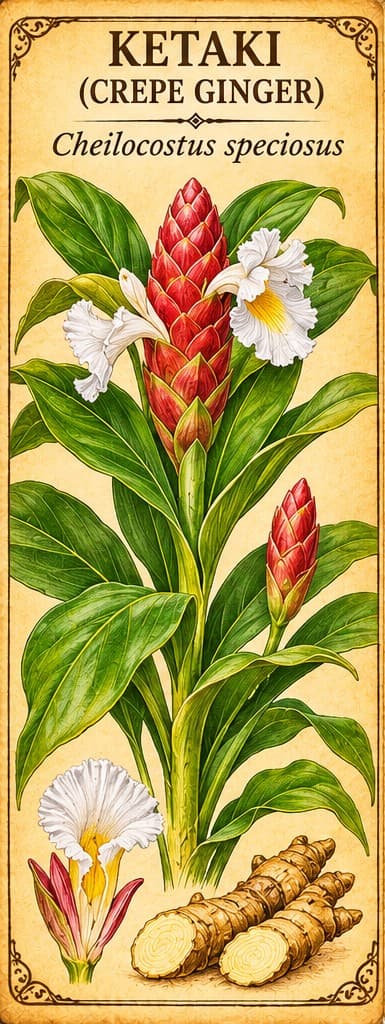
Ketaki
Cheilocostus speciosus
Crepe ginger, an Indian plant with red cone-like flower spikes, long used in traditional medicine. It eased pain and fever in rats.
Safety at a glance
- PregnancyNothing recorded
- BreastfeedingNothing recorded
- MedicinesNothing recorded
- Who should avoid itNothing recorded
- AllergiesNothing recorded
- ToxicityNothing recorded
Tap a box to read the safety notes below. “Nothing recorded” means our sources don't cover it, not that it's safe.
What is Ketaki?
- Plant family
- Costaceae, the spiral ginger family
- Parts used
- The rhizome, leaves and above-ground parts
- Where it grows
- South and Southeast Asia
- Genus
- Cheilocostus
- Species
- speciosus
Also called
Crepe Ginger
Regional names
Keu
Older scientific names
Costus speciosus
Traditionally used for
- Pain
- Fever (traditional)
Traditionally described as
- Medicinal rhizome
What does the research say?
Traditional use
These are traditional uses, not proven treatments.
Crepe ginger (keu) is an Indian ornamental plant that has long been used in traditional medicine.[1]Study
Laboratory & animal research
Lab and animal results show what might be worth studying in people. They don't show that the herb has these effects in humans.
In short
No human or safety studies were found.
Sources
- [1] Antiinflammatory, Analgesic and Antipyretic Activities of Aerial Parts of Costus speciosus Koen. · DOI: 10.4103/0250-474X.113532Peer-reviewed study
- [2] α-glucosidase and glycation inhibitory effects of costus speciosus leaves · DOI: 10.1186/s12906-015-0982-zPeer-reviewed study
This information is educational and traditional in nature, and is not a substitute for professional medical advice. Unfamiliar word? See what these words mean.