
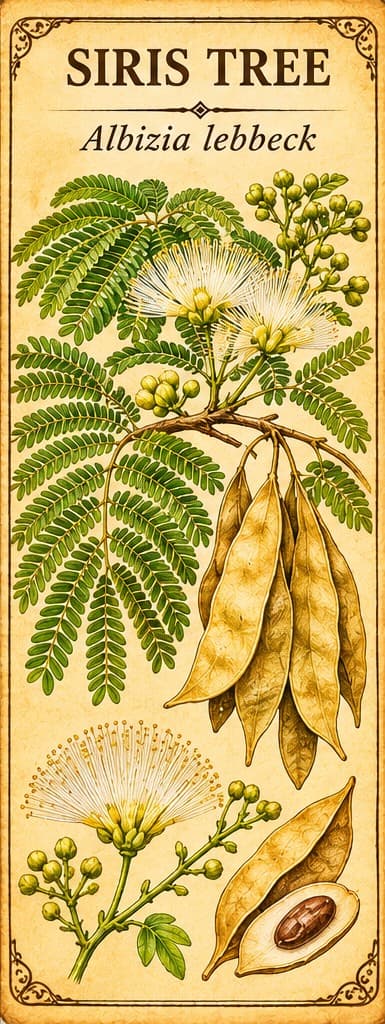
Siris Tree
Albizia lebbeck
Shirisha, the main herb in an Ayurvedic formula for allergies. Its stem bark improved breathing in people with asthma in clinical studies.
Safety at a glance
- PregnancyNothing recorded
- BreastfeedingNothing recorded
- MedicinesNothing recorded
- Who should avoid itNothing recorded
- AllergiesNothing recorded
- ToxicityNothing recorded
Tap a box to read the safety notes below. “Nothing recorded” means our sources don't cover it, not that it's safe.
What is Siris Tree?
- Plant family
- Fabaceae, the pea and bean family
- Parts used
- The bark, leaves, seeds, roots and pods
- Where it grows
- Tropical Asia; now planted worldwide
- Genus
- Albizia
- Species
- lebbeck
Also called
Lebbeck
Traditional names
Shirisha
Traditionally used for
- Allergies
- Asthma (traditional and research)
Traditionally described as
- Antihistamine-like bark
Traditions that use it
- Ayurveda
Main ingredient of Panchashirishadi Agad, a classic formula for allergies and poisoning.
What does the research say?
Traditional use
These are traditional uses, not proven treatments.
Siris (shirisha) is the main ingredient of Panchashirishadi Agad, a classic Ayurvedic formula for allergies and poisoning. Its bark, leaves, seeds, roots and pods are all used in Ayurveda.[1]Review or trial
Laboratory & animal research
Lab and animal results show what might be worth studying in people. They don't show that the herb has these effects in humans.
In rats with a model of Parkinson's disease, siris extract improved movement and endurance and restored the brain's antioxidant defenses.[2]Study
Research in people
A 2026 systematic review of 17 studies found the bark and leaves reduced inflammation and acted like antihistamines. In clinical studies, people with asthma who took stem bark preparations breathed better. Better trials are needed.[1]Review or trial
In short
Better trials are needed to confirm its safety.
Sources
- [1] Panchashirishadi Agad: A Systematic Review of its Anti-Allergic and Immunomodulatory Potential of Albizia lebbeck · DOI: 10.4103/jpbs.jpbs_1562_25Review or clinical trial
- [2] Systems pharmacology based approach to investigate the in-vivo therapeutic efficacy of Albizia lebbeck (L.) in experimental model of Parkinson's disease · DOI: 10.1186/s12906-019-2772-5Peer-reviewed study
This information is educational and traditional in nature, and is not a substitute for professional medical advice. Unfamiliar word? See what these words mean.