
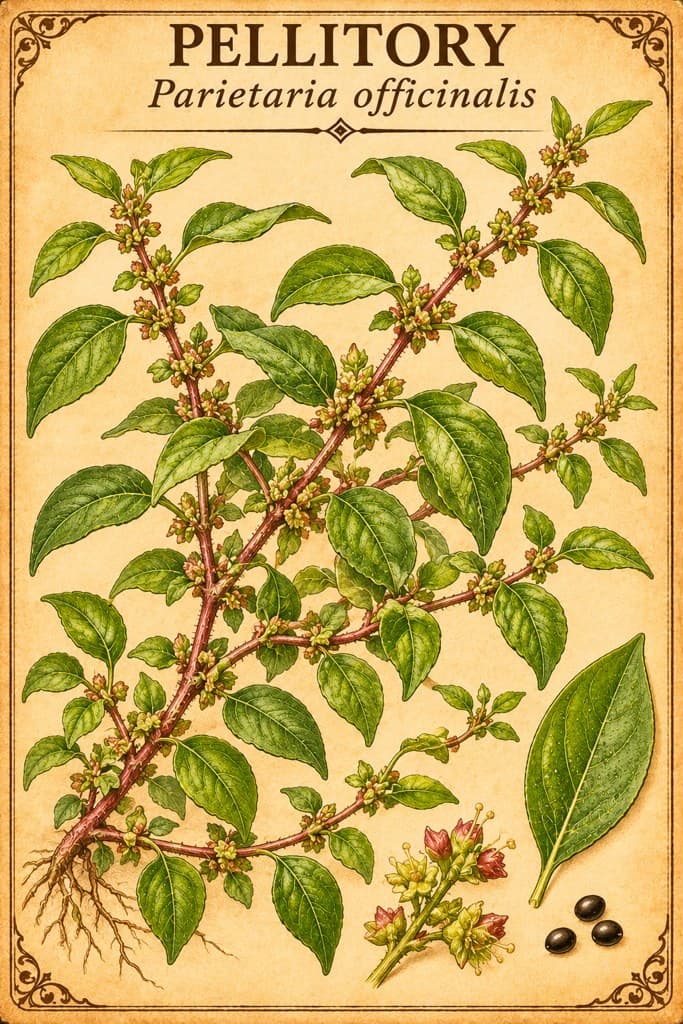
Pellitory
Parietaria officinalis
Pellitory-of-the-wall, a plant whose close relative is used as a tea for urinary infections and swelling. Its pollen is a major cause of hay fever.
Safety at a glance
- PregnancyNothing recorded
- BreastfeedingNothing recorded
- MedicinesNothing recorded
- Who should avoid itNothing recorded
- Allergies2 notes →
- ToxicityNothing recorded
Tap a box to read the safety notes below. “Nothing recorded” means our sources don't cover it, not that it's safe.
What is Pellitory?
- Plant family
- Urticaceae, the nettle family
- Parts used
- The above-ground parts
- Where it grows
- Europe and western Asia
- Genus
- Parietaria
- Species
- officinalis
Also called
Pellitory-of-the-Wall
Traditionally used for
- Urinary infections
- Swelling (traditional
- related species)
Traditionally described as
- Pollen is a common allergen
Safety
Allergies
Pellitory pollen is a major cause of hay fever and allergic asthma, especially around the Mediterranean, where its relative P. judaica is the main cause of pollen allergy. People allergic to one species usually react to the other.[1]Study
In a rare case, pollen from the related P. judaica was suspected of causing anaphylaxis, a severe allergic reaction.[2]Study
What does the research say?
Traditional use
These are traditional uses, not proven treatments.
Pellitory and its close relative Parietaria judaica were historically treated as interchangeable medicines. In Cabo Verde, P. judaica is drunk as a tea for urinary infections, swelling, stomach pain, hemorrhoids, genital infections, diabetes and hair loss.[3]Study
Laboratory & animal research
Lab and animal results show what might be worth studying in people. They don't show that the herb has these effects in humans.
In lab tests, extracts of the related P. judaica acted as antioxidants, fought microbes and harmed some cancer cells more than normal cells.[3]Study
In short
Its pollen commonly causes hay fever and allergic asthma.
Sources
- [1] Cross-reactivity between Parietaria judaica and Parietaria officinalis in immunotherapy extracts for the treatment of allergy to Parietaria · DOI: 10.3892/br.2020.1297Peer-reviewed study
- [2] Anaphylaxis secondary to Parietaria judaica (wall pellitory) · DOI: 10.1136/bcr-2017-220309Peer-reviewed study
- [3] Phytochemical Profile and Selective Anticancer Activity of Parietaria judaica L. Extracts · DOI: 10.3390/molecules30132739Peer-reviewed study
This information is educational and traditional in nature, and is not a substitute for professional medical advice. Unfamiliar word? See what these words mean.