
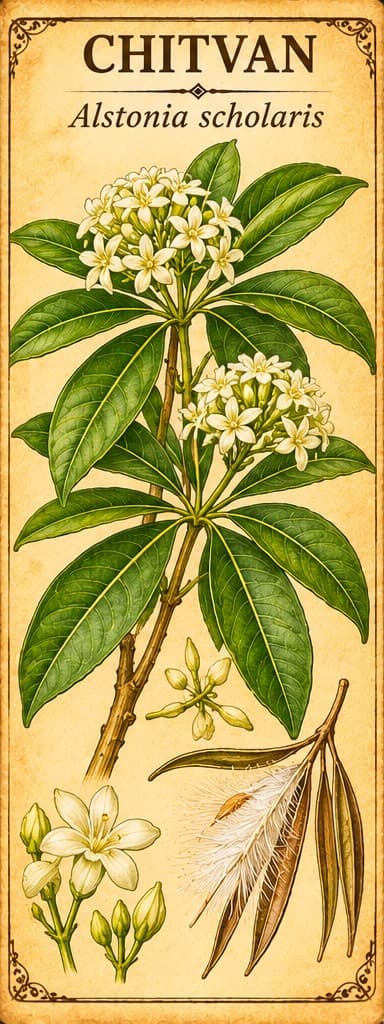
Chitvan
Alstonia scholaris
An Asian tree whose bark has been used by healers since medieval times. Lab and animal studies found a range of effects, but high doses damaged the liver in rats.
Safety at a glance
- PregnancyNothing recorded
- BreastfeedingNothing recorded
- MedicinesNothing recorded
- Who should avoid itNothing recorded
- AllergiesNothing recorded
- Toxicity1 note →
Tap a box to read the safety notes below. “Nothing recorded” means our sources don't cover it, not that it's safe.
What is Chitvan?
- Plant family
- Apocynaceae, the dogbane and milkweed family
- Parts used
- The stem bark
- Where it grows
- South and Southeast Asia to northern Australia
- Genus
- Alstonia
- Species
- scholaris
Traditionally used for
- Traditional medicine
Traditionally described as
- Medicinal bark
Safety
Toxicity testing
In rats, a single large dose of bark extract was not toxic, but daily doses over 28 days changed blood results and damaged the liver at higher doses, and two rats died at the highest dose.[1]Study
What does the research say?
Traditional use
These are traditional uses, not proven treatments.
The bark of chitvan has been used by traditional healers since medieval times.[1]Study
Laboratory & animal research
Lab and animal results show what might be worth studying in people. They don't show that the herb has these effects in humans.
Lab and animal studies have found it may calm inflammation, ease pain, lower blood sugar and cholesterol, and act against malaria and microbes.[1]Study
In short
High daily doses damaged the liver in rats.
Sources
- [1] Acute and Sub-Acute Toxicity Evaluation of the Methanolic Extract of Alstonia scholaris Stem Bark · DOI: 10.3390/medsci4010004Peer-reviewed study
This information is educational and traditional in nature, and is not a substitute for professional medical advice. Unfamiliar word? See what these words mean.