
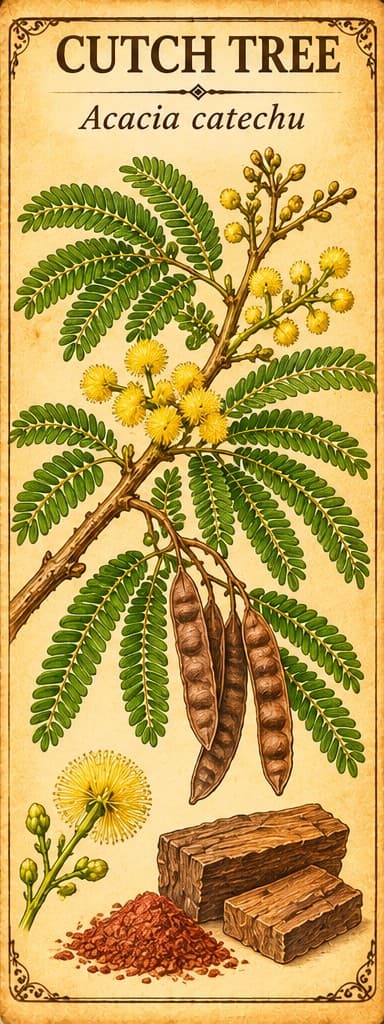
Cutch Tree
Senegalia catechu
Khair, an Asian tree whose heartwood gives katha and cutch. A cutch mouthrinse reduced decay-causing bacteria in children.
Safety at a glance
- PregnancyNothing recorded
- BreastfeedingNothing recorded
- MedicinesNothing recorded
- Who should avoid itNothing recorded
- AllergiesNothing recorded
- ToxicityNothing recorded
Tap a box to read the safety notes below. “Nothing recorded” means our sources don't cover it, not that it's safe.
What is Cutch Tree?
- Plant family
- Fabaceae, the pea and bean family
- Parts used
- The heartwood (katha and cutch)
- Where it grows
- The sub-Himalayan region of India, Pakistan, Nepal, Bhutan, Thailand and China
- Genus
- Senegalia
- Species
- catechu
Also called
Khair, Catechu
Older scientific names
Acacia catechu
Traditionally used for
- Tooth decay
- Traditional medicine
Traditionally described as
- Heartwood extract (katha)
What does the research say?
Traditional use
These are traditional uses, not proven treatments.
Known as khair or cutch, this tree has long been used to treat many ailments. In India, katha and cutch, two commercial products, are made from its heartwood.[1]Review or trial
Laboratory & animal research
Lab and animal results show what might be worth studying in people. They don't show that the herb has these effects in humans.
Lab studies found its extracts harmed several kinds of cancer cells.[1]Review or trial
Research in people
In a trial of 60 young children with tooth decay, a cutch mouthrinse used for 16 days reduced decay-causing mouth bacteria compared with no rinse.[2]Study
In a 12-week trial of 135 adults with knee osteoarthritis, a blend of cutch and white mulberry eased pain and stiffness, but no more than a placebo did. It did reduce a marker of cartilage breakdown compared with placebo.[3]Study
In short
No safety studies were found.
Sources
- [1] A Systematic Review Exploring the Phytochemical Composition and Anticancer Activities of Acacia catechu · DOI: 10.3390/medsci13030161Review or clinical trial
- [2] Comparison of antimicrobial efficacy of Acacia catechu mouthrinse and HiOra herbal mouthrinse and their influence on Streptococcus mutans count and Lactobacillus spp. count in children with early childhood caries · DOI: 10.3205/dgkh000541Peer-reviewed study
- [3] The Effects of Morus alba and Acacia catechu on Quality of Life and Overall Function in Adults with Osteoarthritis of the Knee · DOI: 10.1155/2017/4893104Peer-reviewed study
This information is educational and traditional in nature, and is not a substitute for professional medical advice. Unfamiliar word? See what these words mean.