
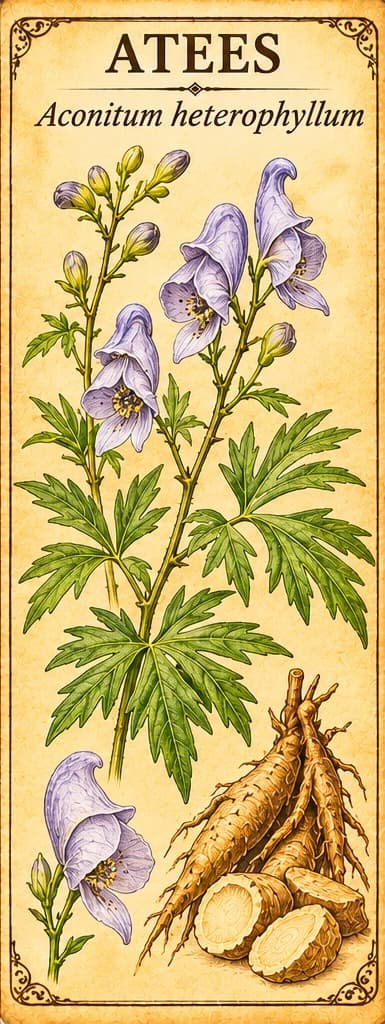
Atees
Aconitum heterophyllum
Ativisha, a Himalayan aconite used in Ayurveda for diarrhea, fever and urinary infections. Its root protected the kidneys in rats.
Safety at a glance
- PregnancyNothing recorded
- BreastfeedingNothing recorded
- MedicinesNothing recorded
- Who should avoid itNothing recorded
- AllergiesNothing recorded
- Toxicity2 notes →
Tap a box to read the safety notes below. “Nothing recorded” means our sources don't cover it, not that it's safe.
What is Atees?
- Plant family
- Ranunculaceae, the buttercup family
- Parts used
- The tuberous root
- Where it grows
- The western Himalayas
- Genus
- Aconitum
- Species
- heterophyllum
Traditional names
Ativisha, Aruna
Traditionally used for
- Diarrhea
- Fever
- Urinary infections (traditional)
Traditionally described as
- Tuberous root
Traditions that use it
- Ayurveda
Called ativisha; used for diarrhea, fever, urinary infections and inflammation.
Safety
What does the research say?
Traditional use
These are traditional uses, not proven treatments.
Atees (ativisha) has been used in Ayurveda since ancient times, for urinary infections, diarrhea, fever and inflammation, and to loosen mucus. For diarrhea it is taken with dry ginger, bael fruit or nutmeg.[1]Study
Laboratory & animal research
Lab and animal results show what might be worth studying in people. They don't show that the herb has these effects in humans.
In rats with sudden kidney failure, a root extract protected the kidneys, and in the lab it was as strong an antioxidant as vitamin C.[3]Study
In short
Unlike most aconites, described as non-toxic.
Sources
- [1] Primary Pharmacological and Other Important Findings on the Medicinal Plant "Aconitum Heterophyllum" (Aruna) · DOI: 10.3831/KPI.2017.20.011Peer-reviewed study
- [2] Population assessment and habitat suitability modelling of endangered medicinal plant, Aconitum heterophyllum Wall. ex Royle in the western Himalaya · DOI: 10.1038/s41598-025-03324-wPeer-reviewed study
- [3] Antioxidant and Nephroprotective Activities of Aconitum heterophyllum Root in Glycerol Induced Acute Renal Failure in Rats · DOI: 10.7860/JCDR/2016/10798.7388Peer-reviewed study
This information is educational and traditional in nature, and is not a substitute for professional medical advice. Unfamiliar word? See what these words mean.