
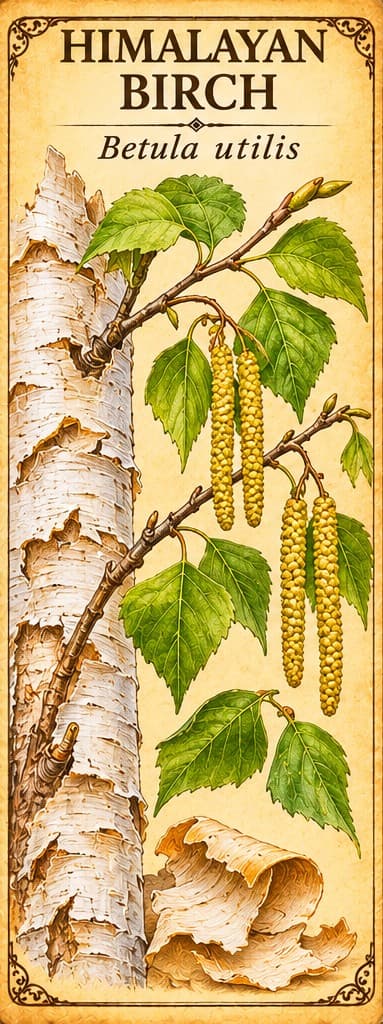
Himalayan Birch
Betula utilis
Bhojpatra, a high-Himalayan birch whose bark is used in traditional medicine. Its compounds harmed cancer cells in the lab and a bark dressing healed wounds in rats.
Safety at a glance
- PregnancyNothing recorded
- BreastfeedingNothing recorded
- MedicinesNothing recorded
- Who should avoid itNothing recorded
- AllergiesNothing recorded
- ToxicityNothing recorded
Tap a box to read the safety notes below. “Nothing recorded” means our sources don't cover it, not that it's safe.
What is Himalayan Birch?
- Plant family
- Betulaceae, the birch family
- Parts used
- The bark
- Where it grows
- The high Himalayas
- Genus
- Betula
- Species
- utilis
Also called
Himalayan Silver Birch
Regional names
Bhojpatra
Traditionally used for
- Inflammation
- Kidney and bladder problems (traditional)
Traditionally described as
- Bark rich in betulinic acid
Natural compounds
What does the research say?
Traditional use
These are traditional uses, not proven treatments.
Himalayan silver birch (bhojpatra) grows high in the Himalayas. It has long been used in traditional medicine for inflammation, kidney and bladder problems, and cancers.[1]Study
In the Himalayas, Himalayan birch bark and root are used for jaundice, burns, leprosy and bronchitis in Ladakh. In western Nepal, the papery bark is laid over wounds to keep them clean, and in Kashmir the powdered bark is taken for leprosy and convulsions and as a tonic.[2]Study
Laboratory & animal research
Lab and animal results show what might be worth studying in people. They don't show that the herb has these effects in humans.
In lab tests, compounds from the bark, including betulinic acid and ursolic acid, harmed several kinds of cancer cells, and ursolic acid targeted breast cancer cells over normal ones.[1]Study
In rats, a gel dressing containing birch bark extract helped wounds close by 93% and killed bacteria.[3]Study
In rats with arthritis, betulinic acid, a compound found in Himalayan birch bark, reduced paw swelling, joint inflammation and cartilage damage.[4]Study
In short
No human or safety studies were found.
Sources
- [1] Isolation, Characterization and Anticancer Potential of Cytotoxic Triterpenes from Betula utilis Bark · DOI: 10.1371/journal.pone.0159430Peer-reviewed study
- [2] Medicinal plants of the genus Betula--traditional uses and a phytochemical-pharmacological review · DOI: 10.1016/j.jep.2014.11.010Peer-reviewed study
- [3] Design and evaluation of sodium alginate-based hydrogel dressings containing Betula utilis extract for cutaneous wound healing · DOI: 10.3389/fbioe.2023.1042077Peer-reviewed study
- [4] Effects of betulinic acid on synovial inflammation in rats with collagen-induced arthritis · DOI: 10.1177/2058738420945078Peer-reviewed study
This information is educational and traditional in nature, and is not a substitute for professional medical advice. Unfamiliar word? See what these words mean.