
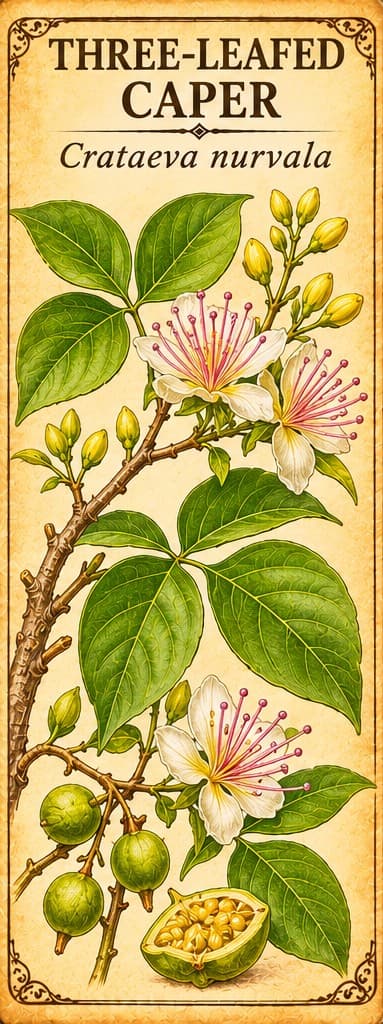
Three-Leafed Caper
Crateva nurvala
An Asian tree used in traditional medicine for kidney and bladder stones, inflammation and fever. Its extracts eased pain and lowered blood sugar in animals.
Safety at a glance
- PregnancyNothing recorded
- BreastfeedingNothing recorded
- MedicinesNothing recorded
- Who should avoid itNothing recorded
- AllergiesNothing recorded
- ToxicityNothing recorded
Tap a box to read the safety notes below. “Nothing recorded” means our sources don't cover it, not that it's safe.
What is Three-Leafed Caper?
- Plant family
- Capparaceae, the caper family
- Parts used
- The stem bark and leaves
- Where it grows
- South and Southeast Asia
- Genus
- Crateva
- Species
- nurvala
Older scientific names
Crataeva nurvala
Traditionally used for
- Kidney and bladder stones
- Inflammation
- Fever (traditional)
Traditionally described as
- Contains lupeol
Natural compounds
What does the research say?
Traditional use
These are traditional uses, not proven treatments.
In traditional medicine, three-leafed caper is used for inflammation, fever, kidney and bladder stones, constipation and as a tonic, and as a contraceptive.[1]Study
Laboratory & animal research
Lab and animal results show what might be worth studying in people. They don't show that the herb has these effects in humans.
Across the Crateva genus, lab and animal studies point to benefits for kidney and bladder stones, inflammation, and liver and kidney problems, often linked to the compound lupeol.[2]Study
In mice, a leaf extract eased pain in several tests.[1]Study
In diabetic rats, stem bark extracts lowered blood sugar.[3]Study
In short
No human or safety studies were found.
Sources
- [1] Evaluation of antinociceptive effect of methanolic extract of leaves of Crataeva nurvala Buch.-Ham. · DOI: 10.1186/1472-6882-14-354Peer-reviewed study
- [2] Crateva religiosa and Allied Species in Traditional Knowledge and Modern Pharmacology: A Review · DOI: 10.1002/cbdv.71597Peer-reviewed study
- [3] Antidiabetic activity of Crateva nurvala stem bark extracts in alloxan-induced diabetic rats · DOI: 10.4103/0975-7406.62700Peer-reviewed study
This information is educational and traditional in nature, and is not a substitute for professional medical advice. Unfamiliar word? See what these words mean.