
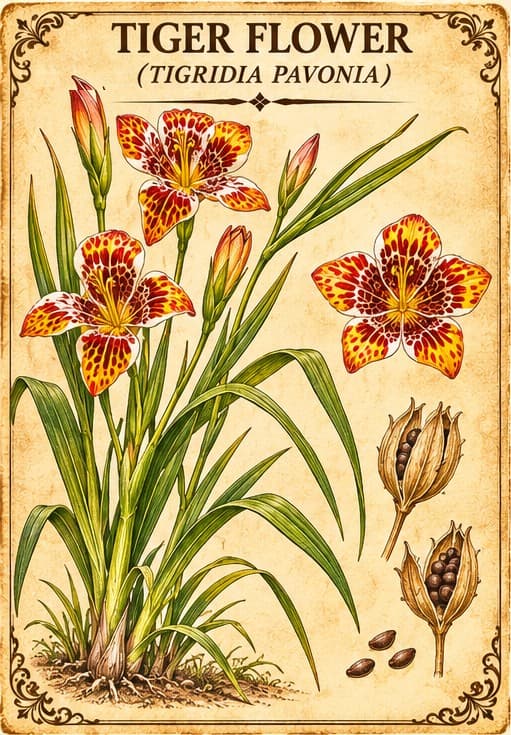
Tiger Flower
Tigridia pavonia
A Mexican iris with spotted flowers, whose small corm is baked and eaten and tastes like sweet potato. Its flowers are offerings to saints in Michoacán.
Safety at a glance
- PregnancyNothing recorded
- BreastfeedingNothing recorded
- MedicinesNothing recorded
- Who should avoid itNothing recorded
- AllergiesNothing recorded
- ToxicityNothing recorded
Tap a box to read the safety notes below. “Nothing recorded” means our sources don't cover it, not that it's safe.
What is Tiger Flower?
- Plant family
- Iridaceae, the iris family
- Parts used
- The corm (bulb) and flowers
- Where it grows
- Mexico and Central America
- Genus
- Tigridia
- Species
- pavonia
Also called
Peacock Flower, Mexican Shell Flower
Regional names
Tlalteztli, Tisa'aí, Cacomite, Flor de Tigre
Traditional names
Oceloxochitl
Traditionally used for
- Food
- Fever
- Infertility (folk use)
- Ceremonial flower
Traditionally described as
- Edible corm
Health topics
Where Tiger Flower appears in symptom search, and why. Being listed doesn't mean it's a proven treatment.
Safety
Depends on how it's prepared
The corm should be cooked; eaten raw it causes an unpleasant burning in the mouth. No medical or safety studies were found.[1]General reference
What does the research say?
Traditional use
These are traditional uses, not proven treatments.
The corm is eaten by Náhuatl communities in the Tehuacán Valley and by Mixtec people in Oaxaca, gathered occasionally from the wild.[2]Study
Baked, the small corm tastes like sweet potato. Eaten raw it burns the mouth. The plant has also been used to promote fertility.[1]General reference
In Purépecha markets in Michoacán, its showy flowers are offerings to saints and decorations for the home. It's the only one of these ceremonial flowers people grow, from seed and by potting the bulbs.[3]Study
In Mexican folk medicine it has been used for chest complaints, fever, childbirth and infertility.[4]Traditional text
Its Nahuatl (Aztec) name is oceloxochitl. A standard Nahuatl dictionary records the bulbs as food and as a remedy for fevers and infertility, though not from early Aztec texts directly.[5]Traditional text
In a study of Mixtec plant knowledge, tiger flower was among the plants listed as edible.[6]Study
In short
Cook the corm; raw it burns the mouth. No medical studies were found.
Sources
- [1] Tigridia pavonia - Tiger Flower — Plants For A FutureGeneral reference
- [2] Ecological and socio-cultural factors influencing plant management in Náhuatl communities of the Tehuacán Valley, Mexico · DOI: 10.1186/1746-4269-9-39Peer-reviewed study
- [3] Cultural, economic, and ecological factors influencing management of wild plants and mushrooms interchanged in Purépecha markets of Mexico · DOI: 10.1186/s13002-018-0269-9Peer-reviewed study
- [4] Ethnobotanical Plant: Tigridia pavonia (citing Martínez M, Las Plantas Medicinales de México, 1969) — Dr. Duke's Phytochemical and Ethnobotanical Databases, USDA Agricultural Research ServiceTraditional text
- [5] oceloxochitl (citing Karttunen F, An Analytical Dictionary of Nahuatl, 1992) — Online Nahuatl Dictionary, ed. Stephanie Wood, Wired Humanities Projects, University of OregonTraditional text
- [6] Are Mixtec Forgetting Their Plants? Intracultural Variation of Ethnobotanical Knowledge in Oaxaca, Mexico · DOI: 10.1007/s12231-021-09535-2Peer-reviewed study
This information is educational and traditional in nature, and is not a substitute for professional medical advice. Unfamiliar word? See what these words mean.