
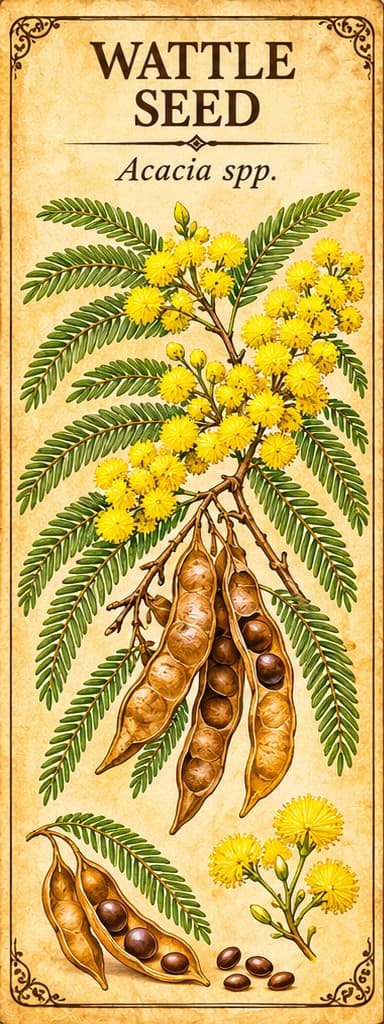
Wattle Seed
Acacia spp.
The roasted, ground seeds of certain Australian wattles, a staple food of Aboriginal communities. They're rich in protein and fiber.
Safety at a glance
- PregnancyNothing recorded
- BreastfeedingNothing recorded
- MedicinesNothing recorded
- Who should avoid itNothing recorded
- AllergiesNothing recorded
- ToxicityNothing recorded
Tap a box to read the safety notes below. “Nothing recorded” means our sources don't cover it, not that it's safe.
What is Wattle Seed?
- Plant family
- Fabaceae, the pea and bean family
- Parts used
- The roasted, ground seeds
- Where it grows
- Australia
- Genus
- Acacia
- Species
- spp.
Also called
Wattleseed, Acacia Seed
Traditionally used for
- Food
- Flavoring
Traditionally described as
- Seeds high in protein
- fiber and minerals
How it's prepared
Common ways Wattle Seed is prepared or sold. This isn't advice on how to take it; see Safety below.
- Culinary Preparation
Seeds roasted and ground into a flavoring or flour.[1]Study
Safety
Depends on how it's prepared
Only certain Acacia species are traditionally eaten, and the seeds are roasted and ground before use. No medical or safety studies were found.[1]Study
What does the research say?
Traditional use
These are traditional uses, not proven treatments.
Wattle seed is a well-known staple food in Aboriginal communities across Australia. Today the roasted, ground seeds are also used to add flavor to food.[1]Study
Wattle seeds were among the many foods of the 90 to 100 Aboriginal language groups of southeastern Australia. Mulga wattle seed (Acacia aneura) has been suggested as suitable for diabetic-friendly diets.[2]Study
Laboratory & animal research
Lab and animal results show what might be worth studying in people. They don't show that the herb has these effects in humans.
In a 2019 study of four wattle species, the seeds were rich in protein (23 to 27%) and fiber (33 to 41%), contained essential amino acids, and some were high in iron, potassium and magnesium.[1]Study
In short
Only certain species are eaten; no medical or safety studies were found.
Sources
- [1] Overall Nutritional and Sensory Profile of Different Species of Australian Wattle Seeds (Acacia spp.): Potential Food Sources in the Arid Semi-Arid Regions · DOI: 10.3390/foods8100482Peer-reviewed study
- [2] Integrating Australian Native Foods for a More Sustainable Food System: A Qualitative Co-Design Study with Aboriginal Communities · DOI: 10.3390/ijerph22040646Peer-reviewed study
This information is educational and traditional in nature, and is not a substitute for professional medical advice. Unfamiliar word? See what these words mean.