
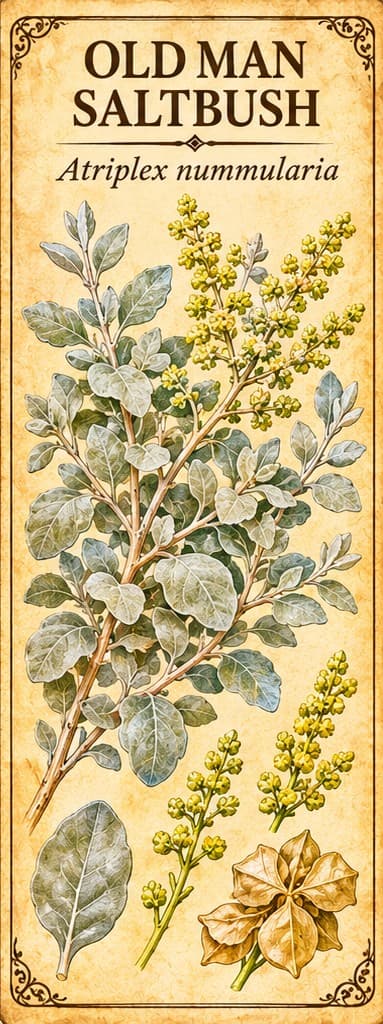
Old Man Saltbush
Atriplex nummularia
An Australian saltbush named for its high mineral content, whose seeds have been eaten and whose leaves feed livestock in dry regions.
Safety at a glance
- PregnancyNothing recorded
- BreastfeedingNothing recorded
- MedicinesNothing recorded
- Who should avoid itNothing recorded
- AllergiesNothing recorded
- ToxicityNothing recorded
Tap a box to read the safety notes below. “Nothing recorded” means our sources don't cover it, not that it's safe.
What is Old Man Saltbush?
- Plant family
- Amaranthaceae, the amaranth family
- Parts used
- The seeds and leaves
- Where it grows
- Australia
- Genus
- Atriplex
- Species
- nummularia
Traditionally used for
- Food
- Livestock feed
Traditionally described as
- Mineral-rich leaves
Safety
Depends on how it's prepared
No human medical or safety studies were found.[1]Study
What does the research say?
Traditional use
These are traditional uses, not proven treatments.
Laboratory & animal research
Lab and animal results show what might be worth studying in people. They don't show that the herb has these effects in humans.
Lab and animal studies found extracts active against fungi and snails, and against ulcerative colitis in rats. The seeds contain 20-hydroxyecdysone, a plant steroid.[1]Study
In short
No human medical or safety studies were found.
Sources
- [1] The Therapeutic Properties, Ethno pharmacology and Phyto-chemistry of Atriplex Species: A review · DOI: 10.52700/pjbb.v2i1.38Peer-reviewed study
- [2] Effect of replacing concentrate feed with leaves of Oldman saltbush (Atriplex nummularia) on feed intake, weight gain, and carcass parameters of highland sheep fed on wheat straw in northern Ethiopia · DOI: 10.1007/s11250-018-1577-8Peer-reviewed study
This information is educational and traditional in nature, and is not a substitute for professional medical advice. Unfamiliar word? See what these words mean.