
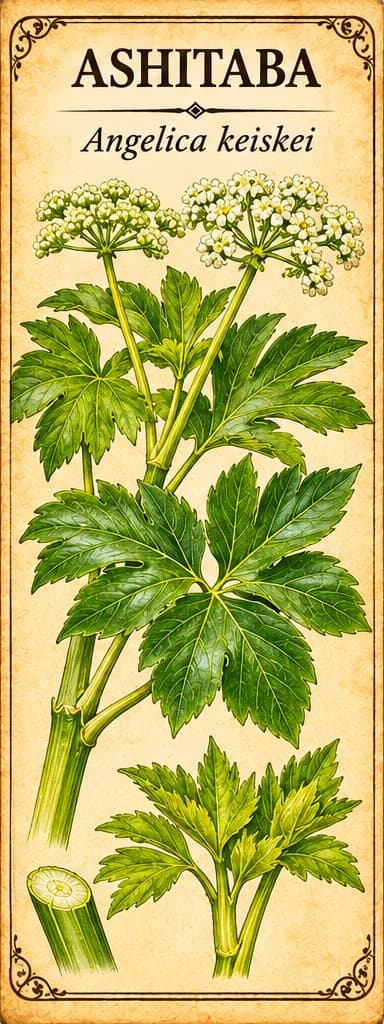
Ashitaba
Angelica keiskei
A Japanese health-food herb. In one trial, its chalcone compounds reduced belly fat and waist size in overweight adults.
Safety at a glance
- PregnancyNothing recorded
- BreastfeedingNothing recorded
- MedicinesNothing recorded
- Who should avoid itNothing recorded
- AllergiesNothing recorded
- ToxicityNothing recorded
Tap a box to read the safety notes below. “Nothing recorded” means our sources don't cover it, not that it's safe.
What is Ashitaba?
- Plant family
- Apiaceae, the carrot and parsley family
- Parts used
- The leaves and stems
- Where it grows
- Japan
- Genus
- Angelica
- Species
- keiskei
Traditionally used for
- Food
- Weight management
Traditionally described as
- Rich in chalcones such as xanthoangelol
Health topics
Where Ashitaba appears in symptom search, and why. Being listed doesn't mean it's a proven treatment.
- Menopausal Weight Gain
Chalcone capsules reduced belly fat and waist size in overweight adults in one trial; not tested specifically in menopause.
Natural compounds
Safety
Side effects
Ashitaba extracts didn't irritate the skin or cause sun sensitivity when tested on rabbits and guinea pigs. No human safety studies were found.[1]Study
What does the research say?
Traditional use
These are traditional uses, not proven treatments.
Ashitaba is a Japanese herb traditionally eaten as a health-promoting food and used as an herbal medicine.[2]Study
Laboratory & animal research
Lab and animal results show what might be worth studying in people. They don't show that the herb has these effects in humans.
In dogs with gum disease, an ashitaba gel used daily for 4 weeks improved gum inflammation and bad breath, and the extract killed the bacteria involved in lab tests.[2]Study
Research in people
In a 12-week placebo-controlled trial of 42 overweight adults, capsules of ashitaba chalcones (16 mg a day) reduced belly fat measured by CT scan and shrank waist size compared with placebo.[3]Study
In a small study of 10 older adults, eating 5 g of dried ashitaba powder raised blood levels of plant pigments such as quercetin and lutein within hours.[4]Study
In short
No human safety studies were found.
Sources
- [1] Evaluation of acute skin irritation and phototoxicity by aqueous and ethanol fractions of Angelica keiskei · DOI: 10.3892/etm.2012.782Peer-reviewed study
- [2] Bactericidal and Anti-Inflammatory Effects of Ashitaba-Extract Ameliorate the Gingivitis and Halitosis in Dogs with Porphyromonas gulae-Infected Periodontal Disease · DOI: 10.3390/vetsci12100981Peer-reviewed study
- [3] Randomised, double-blind, parallel group comparison of Ashitaba (Angelica Keiskei) chalcone effects on visceral fat areas and waist circumference of overweight persons · DOI: 10.1080/09637486.2024.2334070Peer-reviewed study
- [4] Bioavailability of plant pigment phytochemicals in Angelica keiskei in older adults: A pilot absorption kinetic study · DOI: 10.4162/nrp.2014.8.5.550Peer-reviewed study
This information is educational and traditional in nature, and is not a substitute for professional medical advice. Unfamiliar word? See what these words mean.