
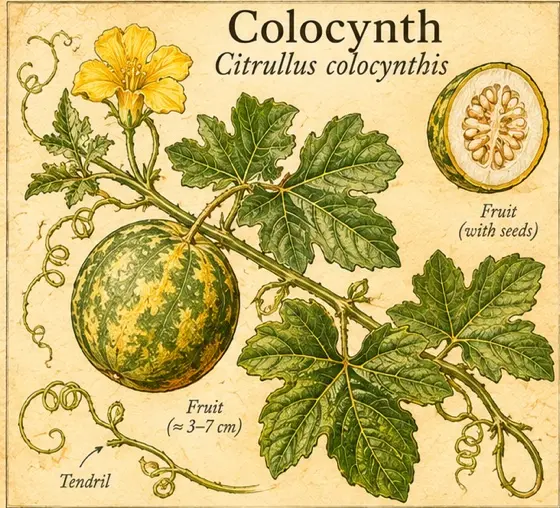
Colocynth
Citrullus colocynthis
A desert relative of melons with intensely bitter fruits, traditionally used as a strong laxative. It didn't lower blood sugar in diabetes trials, and eating the fruit can cause serious poisoning.
Safety at a glance
- PregnancyNothing recorded
- BreastfeedingNothing recorded
- MedicinesNothing recorded
- Who should avoid itNothing recorded
- AllergiesNothing recorded
- Toxicity1 note →
Tap a box to read the safety notes below. “Nothing recorded” means our sources don't cover it, not that it's safe.
What is Colocynth?
- Plant family
- Cucurbitaceae, the gourd and cucumber family
- Parts used
- The fruit pulp and seeds
- Where it grows
- Deserts of North Africa, the Middle East and South Asia
- Genus
- Citrullus
- Species
- colocynthis
Also called
Bitter Apple, Desert Gourd
Regional names
Hanzal
Traditionally used for
- Constipation (traditional purgative)
- Diabetes (studied
- no clear effect)
Traditionally described as
- Extremely bitter; rich in cucurbitacins
Health topics
Where Colocynth appears in symptom search, and why. Being listed doesn't mean it's a proven treatment.
- Constipation
Traditionally used as a strong laxative, but it can cause serious poisoning.
- High Blood Sugar
Pooled small trials found it didn't lower blood sugar in type 2 diabetes.
- Poisonous Plants
A strong purgative that can cause bloody diarrhea, kidney injury and liver damage.
Natural compounds
Safety
Toxicity testing
Colocynth is seriously poisonous in larger amounts. A 64-year-old man ate colocynth fruit for constipation. Within 2 hours he had heavy bloody diarrhea, was vomiting blood and became confused. He then developed low blood pressure, kidney injury and liver damage. He recovered after 5 days of hospital care.[1]Study
Technical detail: hypotension, sinus tachycardia, leukocytosis, acute kidney injury and raised liver enzymes; infectious causes of colitis were excluded.
What does the research say?
Traditional use
These are traditional uses, not proven treatments.
Colocynth, a relative of melons, has traditionally been used as a strong laxative (purgative).[1]Study
Laboratory & animal research
Lab and animal results show what might be worth studying in people. They don't show that the herb has these effects in humans.
Its main active compounds are cucurbitacins, along with flavonoids and polyphenols. In lab and animal studies, colocynth has been tested for effects on blood sugar, blood fats, germs, inflammation, pain and cancer cells.[2]Study
Technical detail: reported activities include antioxidative, hypoglycemic, antibacterial, anticancer, anti-inflammatory, analgesic and hypolipidemic effects.
Research in people
A 2022 review pooled 3 small trials in people with type 2 diabetes. Colocynth didn't lower fasting blood sugar, long-term blood sugar (HbA1c), LDL cholesterol or triglycerides. It slightly raised HDL ("good") cholesterol. The trials were few and of fairly low quality.[3]Review or trial
Technical detail: HDL mean difference 5.76 (95% CI 1.69 to 9.84; P = 0.006; I² = 0%).
In short
Poisonous in larger amounts: it can cause bloody diarrhea, kidney injury and liver damage.
Sources
- [1] Colocynth induced multiorgan toxicity: a case report · DOI: 10.1186/s13256-025-05542-2Peer-reviewed study
- [2] Citrullus colocynthis (L.) Schrad (Bitter Apple Fruit): Promising Traditional Uses, Pharmacological Effects, Aspects, and Potential Applications · DOI: 10.3389/fphar.2021.791049Peer-reviewed study
- [3] Effect of Citrullus colocynthis on glycemic factors and lipid profile in type II diabetic patients: a systematic review and meta-analysis · DOI: 10.1007/s40200-022-01045-9Review or clinical trial
This information is educational and traditional in nature, and is not a substitute for professional medical advice. Unfamiliar word? See what these words mean.