
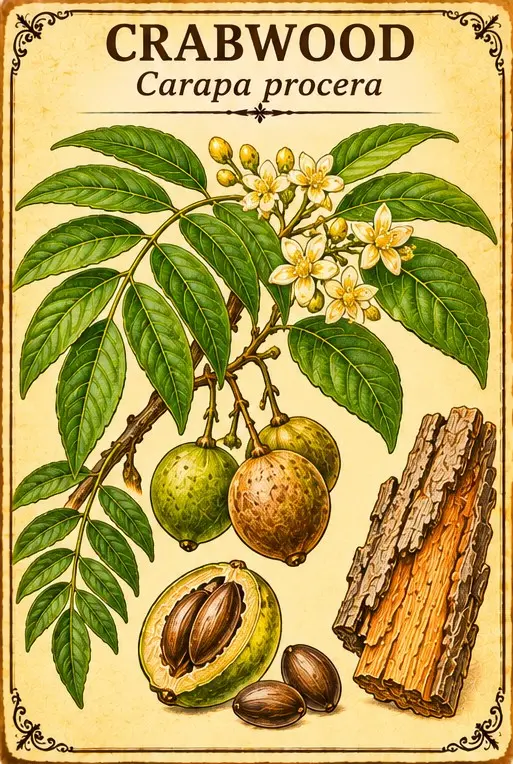
Crabwood
Carapa procera
A West African oil tree whose seed oil is used in cosmetics and to repel mosquitoes, flies and ants. Healers use it for malaria; extracts slowed malaria in mice.
Safety at a glance
- PregnancyNothing recorded
- BreastfeedingNothing recorded
- MedicinesNothing recorded
- Who should avoid itNothing recorded
- AllergiesNothing recorded
- Toxicity1 note →
Tap a box to read the safety notes below. “Nothing recorded” means our sources don't cover it, not that it's safe.
What is Crabwood?
- Plant family
- Meliaceae, the mahogany family
- Parts used
- The seed oil, bark and leaves
- Where it grows
- Tropical Africa and South America
- Genus
- Carapa
- Species
- procera
Traditionally used for
- Cosmetics
- Insect repellent
- Malaria (traditional)
Traditionally described as
- Seed oil; bark contains limonoids
- tannins and saponins
Health topics
Where Crabwood appears in symptom search, and why. Being listed doesn't mean it's a proven treatment.
- Fever
A traditional malaria remedy; slowed malaria in mice. Not tested in people.
Safety
Toxicity testing
In animal safety tests, leaf fractions caused no deaths or changes in blood tests, but the highest dose caused reversible liver changes in rats.[1]Study
What does the research say?
Traditional use
These are traditional uses, not proven treatments.
An oil tree prized in West Africa. In Mali the nuts are its most used part, pressed for an oil used mainly in cosmetics, while the bark, leaves and roots are used as medicine.[2]Study
In Côte d'Ivoire the seed oil is used to keep off flies, mosquitoes and ants, and the plant is also used for malaria, tiredness and cosmetics.[3]Study
Traditional healers in western Burkina Faso use it for malaria.[4]Study
Laboratory & animal research
Lab and animal results show what might be worth studying in people. They don't show that the herb has these effects in humans.
In short
High doses caused reversible liver changes in rats.
Sources
- [1] Assessment of toxicity and anti-plasmodial activities of chloroform fractions of Carapa procera and Alchornea cordifolia in murine models · DOI: 10.3389/fphar.2022.1077380Peer-reviewed study
- [2] Use-value and importance of socio-cultural knowledge on Carapa procera trees in the Sudanian zone in Mali · DOI: 10.1186/1746-4269-11-14Peer-reviewed study
- [3] Qualitative ethnobotanical survey on the virtues of Carapa procera and plants used for protection against mosquitoes in Côte d'Ivoire · DOI: 10.1186/s12936-025-05531-2Peer-reviewed study
- [4] In vivo Antimalarial, Antioxidant Activities and Safety of Carapa procera DC. (Meliaceae) · DOI: 10.3923/pjbs.2021.571.578Peer-reviewed study
- [5] Phytochemical and proximate content of Carapa procera bark and its antimicrobial potential against selected pathogens · DOI: 10.1371/journal.pone.0261755Peer-reviewed study
This information is educational and traditional in nature, and is not a substitute for professional medical advice. Unfamiliar word? See what these words mean.