
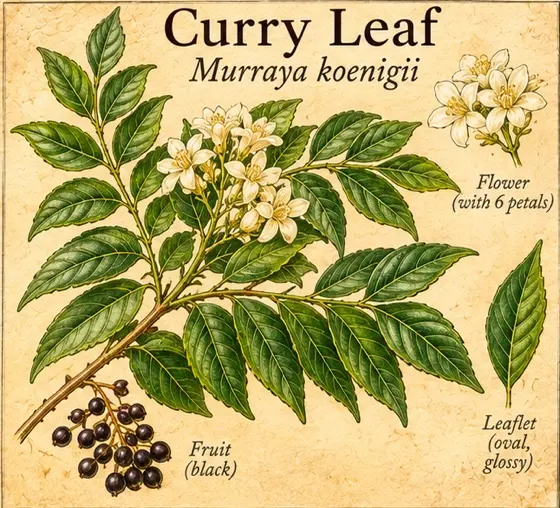
Curry Leaf
Murraya koenigii
The aromatic leaves of a tropical tree used throughout Indian cooking and valued in Ayurveda for piles, inflammation, dysentery and diabetes. Lab studies show effects on blood sugar, but it hasn't been tested in people.
Safety at a glance
- PregnancyNothing recorded
- BreastfeedingNothing recorded
- MedicinesNothing recorded
- Who should avoid itNothing recorded
- AllergiesNothing recorded
- ToxicityNothing recorded
Tap a box to read the safety notes below. “Nothing recorded” means our sources don't cover it, not that it's safe.
What is Curry Leaf?
- Plant family
- Rutaceae, the citrus family
- Parts used
- The fresh leaves (also the fruit, bark and roots)
- Where it grows
- India and Southeast Asia
- Genus
- Murraya
- Species
- koenigii
Also called
Sweet Neem
Regional names
Kadi Patta, Karuveppilai
Traditionally used for
- Cooking
- Diabetes (traditional)
- Dysentery and inflammation (traditional Ayurveda)
Traditionally described as
- Leaves rich in carbazole alkaloids
Health topics
Where Curry Leaf appears in symptom search, and why. Being listed doesn't mean it's a proven treatment.
- High Blood Sugar
A traditional diabetes remedy; it lowered blood sugar in lab and animal studies only.
Traditions that use it
- Ayurveda
Highly valued in Ayurveda: the leaves for piles, inflammation, itching, cuts, dysentery and swelling; the roots for body aches.
Natural compounds
What does the research say?
Traditional use
These are traditional uses, not proven treatments.
Curry leaf, also called sweet neem, is a tropical tree from India and Southeast Asia. It's highly valued in Ayurveda, and almost every part is used. The fresh leaves are traditionally used for:
- Piles
- Inflammation and itching
- Fresh cuts
- Dysentery
- Swelling
Curry leaf mixed with buttermilk is used for amoebic dysentery, diabetes and hepatitis. The bark is a traditional snakebite remedy, and the roots are used for body aches.[1]Study
Laboratory & animal research
Lab and animal results show what might be worth studying in people. They don't show that the herb has these effects in humans.
The leaves, roots and bark are rich in carbazole alkaloids. In lab and animal studies, these have acted as antioxidants and against diabetes, inflammation and tumors, and have protected nerve cells.[2]Study
In lab and animal studies, curry leaf lowered blood sugar and blood fats and reduced weight gain. These effects haven't been confirmed in people.[1]Study
Technical detail: anti-diabetic, anti-hyperglycemic, antihyperlipidemic and anti-obesity activity in vitro and in vivo.
Studies suggest the leaves may protect the liver, regulate the immune system, fight germs and protect nerve cells. Researchers are interested in them for brain diseases such as Alzheimer's, but this work is at an early stage.[3]Study
In short
Medicinal effects haven't been tested in human trials.
Sources
- [1] Murraya koenigii (L.) Spreng. as a Natural Intervention for Diabesity: A Review · DOI: 10.2174/0113816128304471240801183021Peer-reviewed study
- [2] Medicinal Profile, Phytochemistry, and Pharmacological Activities of Murraya koenigii and its Primary Bioactive Compounds · DOI: 10.3390/antiox9020101Peer-reviewed study
- [3] Multi-Target Approach of Murraya koenigii Leaves in Treating Neurodegenerative Diseases · DOI: 10.3390/ph15020188Peer-reviewed study
This information is educational and traditional in nature, and is not a substitute for professional medical advice. Unfamiliar word? See what these words mean.