
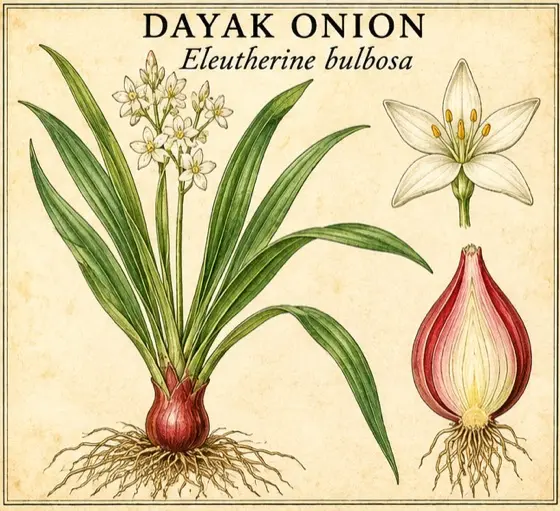
Dayak Onion
Eleutherine bulbosa
An iris-family plant with a red onion-like bulb, used for high blood pressure, ulcers and constipation. It lowered blood pressure in pregnant rodents, but hasn't been tested in people.
Safety at a glance
- Pregnancy1 note →
- BreastfeedingNothing recorded
- MedicinesNothing recorded
- Who should avoid itNothing recorded
- AllergiesNothing recorded
- Toxicity1 note →
Tap a box to read the safety notes below. “Nothing recorded” means our sources don't cover it, not that it's safe.
What is Dayak Onion?
- Plant family
- Iridaceae, the iris family
- Parts used
- The red bulb
- Where it grows
- Tropical America; now grown widely in Southeast Asia, especially Borneo
- Genus
- Eleutherine
- Species
- bulbosa
Also called
Forest Onion
Traditional names
Bawang Dayak, Marupazinho
Older scientific names
Eleutherine americana, Eleutherine palmifolia
Traditionally used for
- High blood pressure (traditional and animal research)
- Ulcers and constipation (traditional)
Traditionally described as
- Red bulb used as medicine and food
Health topics
Where Dayak Onion appears in symptom search, and why. Being listed doesn't mean it's a proven treatment.
- Constipation
Used for constipation in Brazilian folk medicine.
- High Blood Pressure
Traditionally used for high blood pressure; lowered systolic pressure in pregnant rodents.
- Stomach Ulcers and H. pylori
Used for ulcers in Brazilian folk medicine.
Safety
Pregnancy
Although it has been studied for high blood pressure in pregnancy, that research was in animals only. Its safety in pregnant women is unknown.[1]Study
Toxicity testing
In zebrafish, a concentrated bulb extract was quite toxic at higher doses, although low doses appeared safe. There are no safety studies in people.[2]Study
Technical detail: LD50 346.74 mg/kg for the hexane fraction of the ethanolic extract.
What does the research say?
Traditional use
These are traditional uses, not proven treatments.
Dayak onion is a small plant of the iris family with a red, onion-like bulb and white flowers. It isn't a true onion. In Brazil, where it's called marupazinho, it's often used in traditional medicine for:
- High blood pressure
- Ulcers
- Constipation
- Gut infections
Laboratory & animal research
Lab and animal results show what might be worth studying in people. They don't show that the herb has these effects in humans.
In lab tests, a forest onion extract blocked enzymes that digest fat, starch and sugar. In mouse fat cells, it also affected proteins involved in handling fats and sugar. The authors suggest it could be a functional food for metabolic syndrome, but it hasn't been tested in people.[3]Study
Technical detail: inhibited pancreatic lipase, α-glucosidase and α-amylase; reduced MAPK8, PPARG, HMGCR, CPT-1 and GLP-1 expression in 3T3-L1 cells.
In female rodents with a condition like pre-eclampsia (dangerously high blood pressure in pregnancy), a Dayak onion bulb extract lowered the top number of blood pressure (systolic). The effect on the bottom number (diastolic) was unclear. This is an animal study only.[1]Study
Technical detail: 96% ethanol extract at 90, 100 and 125 mg/kg; 30 animals in five groups.
In zebrafish, a bulb extract reduced swelling caused by an irritant at very low doses.[2]Study
Technical detail: hexane fraction of the ethanolic extract; carrageenan-induced abdominal edema inhibited by 66.2% and 62.4% at 2.5 mg/kg.
In short
Concentrated extracts were toxic to zebrafish at higher doses. No human studies.
Sources
- [1] The effect of giving 96% ethanol extract of dayak onion bulb on blood pressure reduction in a preclampsia mice model · DOI: 10.5455/OVJ.2025.v15.i11.36Peer-reviewed study
- [2] Toxicity and Anti-inflammatory Effects of Eleutherine bulbosa (Miller) Urb, Ethanolic Extract, in Zebrafish (Danio rerio) · DOI: 10.2174/0118715230352701241130053455Peer-reviewed study
- [3] Novel Functional Food Properties of Forest Onion (Eleutherine bulbosa Merr.) Phytochemicals for Treating Metabolic Syndrome: New Insights from a Combined Computational and In Vitro Approach · DOI: 10.3390/nu16101441Peer-reviewed study
This information is educational and traditional in nature, and is not a substitute for professional medical advice. Unfamiliar word? See what these words mean.