
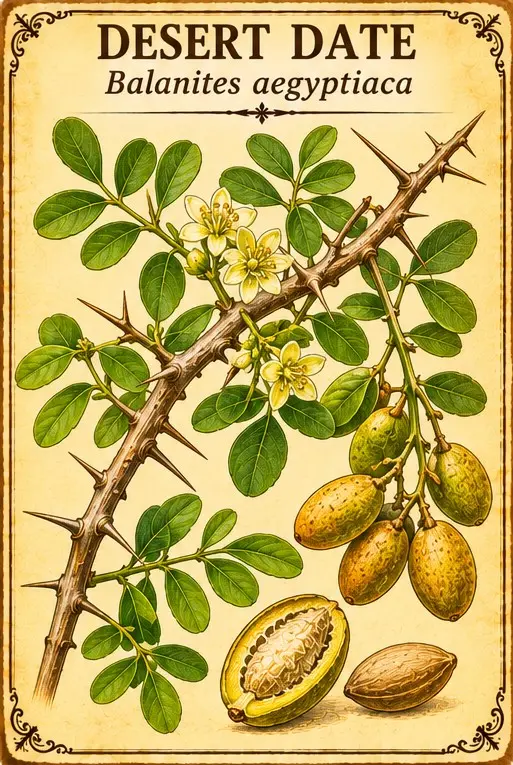
Desert Date
Balanites aegyptiaca
A spiny desert tree whose fruit is a traditional remedy for high blood sugar. In a small pilot trial, fruit rind capsules lowered after-meal blood sugar in type 2 diabetes.
Safety at a glance
- PregnancyNothing recorded
- BreastfeedingNothing recorded
- MedicinesNothing recorded
- Who should avoid itNothing recorded
- AllergiesNothing recorded
- ToxicityNothing recorded
Tap a box to read the safety notes below. “Nothing recorded” means our sources don't cover it, not that it's safe.
What is Desert Date?
- Plant family
- Zygophyllaceae, the caltrop family
- Parts used
- The fruit, seeds, bark and leaves
- Where it grows
- Dry lands of Africa, the Middle East and South Asia
- Genus
- Balanites
- Species
- aegyptiaca
Traditionally used for
- Diabetes
- Worms
- Jaundice
- Fever (traditional)
Traditionally described as
- Fruit contains steroidal saponins
Health topics
Where Desert Date appears in symptom search, and why. Being listed doesn't mean it's a proven treatment.
- High Blood Sugar
Lowered after-meal blood sugar in a small pilot trial in type 2 diabetes.
Safety
Depends on how it's prepared
Only one small human trial has been done. It shouldn't replace diabetes medicine.[1]Study
What does the research say?
Traditional use
These are traditional uses, not proven treatments.
A spiny desert tree whose date-like fruit is traditionally used for high blood sugar. It's also used for jaundice, worms, wounds, malaria, syphilis, epilepsy, diarrhea, constipation, hemorrhoids, stomach aches, asthma and fever.[2]Study
Laboratory & animal research
Lab and animal results show what might be worth studying in people. They don't show that the herb has these effects in humans.
A 2025 review of 32 animal studies found it lowered blood sugar in every diabetic animal study, whatever plant part was used.[3]Review or trial
Research in people
In a small 8-week trial of 30 older Egyptians with type 2 diabetes, capsules of the fruit rind cut after-meal blood sugar by about 27% and improved cholesterol, with no low blood sugar episodes.[1]Study
In short
Only one small human trial; not a replacement for diabetes medicine.
Sources
- [1] Randomized double-blinded pilot clinical study of the antidiabetic activity of Balanites aegyptiaca and UPLC-ESI-MS/MS identification of its metabolites · DOI: 10.1080/13880209.2017.1354388Peer-reviewed study
- [2] A review on Balanites aegyptiaca Del (desert date): phytochemical constituents, traditional uses, and pharmacological activity · DOI: 10.4103/0973-7847.79100Peer-reviewed study
- [3] Therapeutic effects of Balanites aegyptiaca DEL extract on diabetes mellitus: a systematic review · DOI: 10.3389/fcdhc.2025.1651789Review or clinical trial
This information is educational and traditional in nature, and is not a substitute for professional medical advice. Unfamiliar word? See what these words mean.