
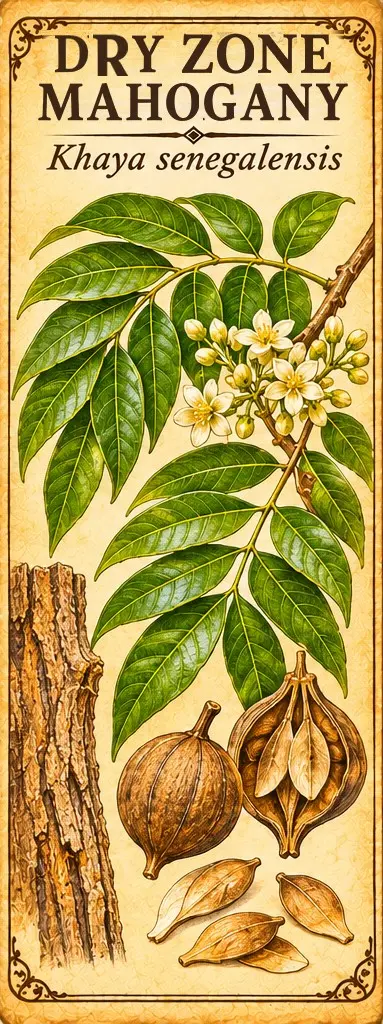
Dry Zone Mahogany
Khaya senegalensis
African mahogany, a savanna timber tree whose bark is a West African remedy for diarrhea, malaria and fever. A bark extract eased diarrhea in rats.
Safety at a glance
- PregnancyNothing recorded
- BreastfeedingNothing recorded
- MedicinesNothing recorded
- Who should avoid itNothing recorded
- AllergiesNothing recorded
- Toxicity1 note →
Tap a box to read the safety notes below. “Nothing recorded” means our sources don't cover it, not that it's safe.
What is Dry Zone Mahogany?
- Plant family
- Meliaceae, the mahogany family
- Parts used
- The stem bark and leaves
- Where it grows
- Sub-Saharan Africa
- Genus
- Khaya
- Species
- senegalensis
Also called
African Mahogany
Regional names
Madaci, Ono, Oganwon, Chiha
Traditionally used for
- Diarrhea
- Malaria
- Fever
- Wounds (traditional)
Traditionally described as
- Bark rich in tannins; leaves contain beta-sitosterol
Health topics
Where Dry Zone Mahogany appears in symptom search, and why. Being listed doesn't mean it's a proven treatment.
Traditions that use it
- African Traditional Medicine
Stem bark decoctions used across West Africa for diarrhea, malaria and fever.
Safety
Toxicity testing
In rats, a water extract of the stem bark taken for 21 days lowered red blood cells and hemoglobin, and another study suggested it may harm vital organs, so long-term use may be harmful.[1]Study
Depends on how it's prepared
No human medical or safety studies were found.[2]Review or trial
What does the research say?
Traditional use
These are traditional uses, not proven treatments.
A decoction of the stem bark is used for diarrhea with mucus, malaria, fever, venereal diseases and hookworm.[3]Study
In Benin it's among the plants used for snakebite, though few studies have looked at this use.[2]Review or trial
Valued for its timber, the tree's leaves are also used in traditional wound care.[4]Study
Across tropical Africa it's also used for dysentery, wound infections, diabetes, high blood pressure, jaundice, skin problems, scorpion stings, mental illness, leprosy, infertility, headache, syphilis, gum infections and allergies, and as a laxative and aphrodisiac.[1]Study
Laboratory & animal research
Lab and animal results show what might be worth studying in people. They don't show that the herb has these effects in humans.
In rats, a stem bark extract delayed and reduced diarrhea, working about as well as loperamide (Imodium) on some measures.[3]Study
In lab tests, compounds from the leaves helped human skin cells close scratch wounds and weren't harmful to skin cells.[4]Study
In rat studies reviewed in 2022, bark extracts protected the liver from chemical damage, reduced stomach ulcers, swelling and pain, and reduced seizures and anxiety. In sheep, a bark extract cut worm egg counts by about 89%. In lab tests, the stem bark was strongly active against malaria parasites.[1]Study
In short
No human medical or safety studies were found.
Sources
- [1] A Review of the Phytochemistry and Pharmacology of the Medicinal Plant: Khaya Senegalensis (Desr.) A. Juss · DOI: 10.55248/gengpi.2022.3.8.41Peer-reviewed study
- [2] Traditional medicinal knowledge and diversity of medicinal plants in Benin: a systematic review (2014-2023) · DOI: 10.1186/s12906-026-05440-0Review or clinical trial
- [3] In-vivo antidiarrheal activity of aqueous and hydroethanolic extracts of Anacardium occidentale and Khaya senegalensis used in Benin (West Africa) in a castor oil-induced diarrhea model traditionally · DOI: 10.3389/fphar.2026.1812204Peer-reviewed study
- [4] Bioassay-guided fractionation and identification of wound healing active compounds from Khaya senegalensis leaves · DOI: 10.1371/journal.pone.0339051Peer-reviewed study
This information is educational and traditional in nature, and is not a substitute for professional medical advice. Unfamiliar word? See what these words mean.