
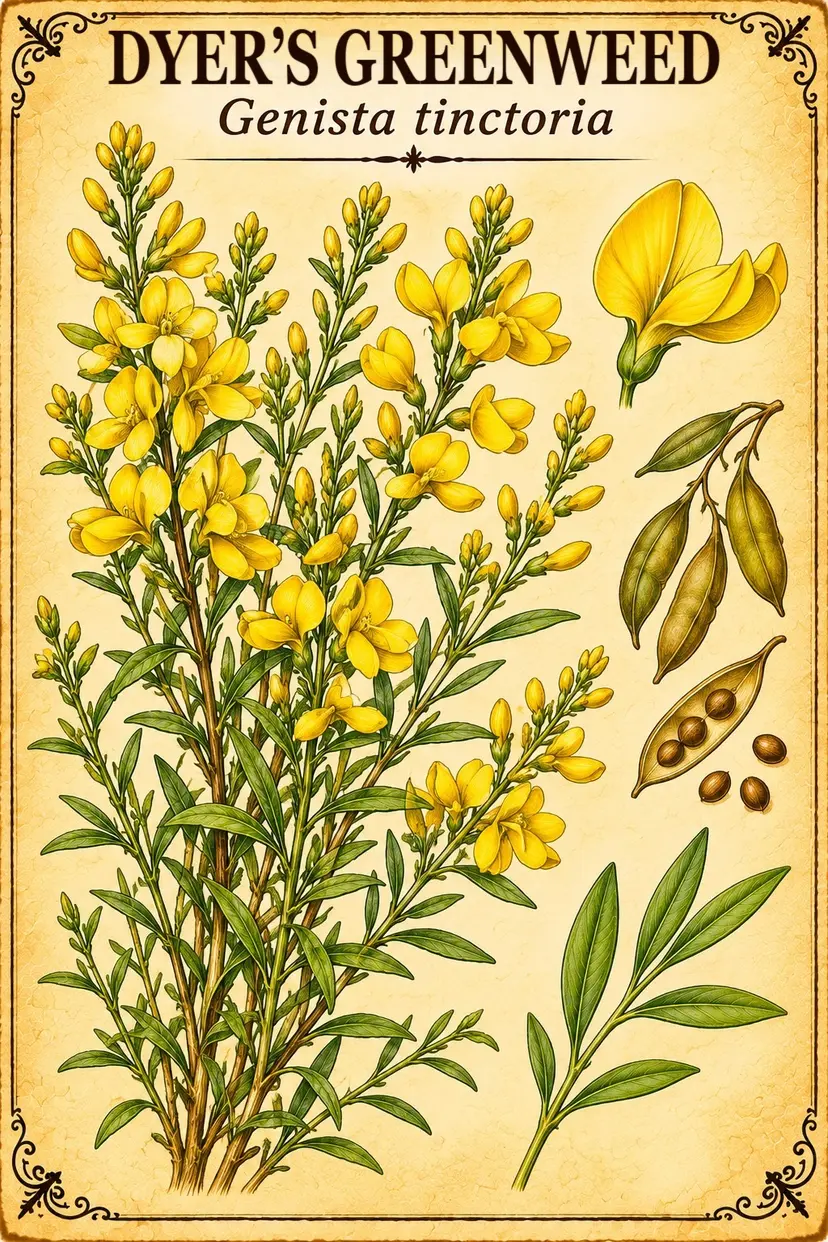
Dyer's Greenweed
Genista tinctoria
A pea-family plant containing isoflavones. In lab tests, its extract protected DNA from UV damage and slowed melanoma cells.
Safety at a glance
- PregnancyNothing recorded
- BreastfeedingNothing recorded
- MedicinesNothing recorded
- Who should avoid itNothing recorded
- AllergiesNothing recorded
- ToxicityNothing recorded
Tap a box to read the safety notes below. “Nothing recorded” means our sources don't cover it, not that it's safe.
What is Dyer's Greenweed?
- Plant family
- Fabaceae, the pea and bean family
- Parts used
- The above-ground parts
- Genus
- Genista
- Species
- tinctoria
Traditionally used for
- Lab research only
Traditionally described as
- Contains isoflavones
Safety
Depends on how it's prepared
There are no human safety studies.[1]Study
What does the research say?
Traditional use
These are traditional uses, not proven treatments.
A pea-family plant. Like other Genista plants, it contains isoflavones, plant compounds that have shown estrogen-like and other effects.[2]Study
Laboratory & animal research
Lab and animal results show what might be worth studying in people. They don't show that the herb has these effects in humans.
In lab tests, an extract protected DNA from damage by UV light and slowed the growth of melanoma cells. It hasn't been tested in people.[2]Study
In short
No human safety studies.
Sources
- [1] Dyer's Greenweed (Genista tinctoria L.): constituents and biological activityPeer-reviewed study
- [2] Genista sessilifolia DC. and Genista tinctoria L. inhibit UV light and nitric oxide-induced DNA damage and human melanoma cell growth · DOI: 10.1016/j.cbi.2009.02.010Peer-reviewed study
This information is educational and traditional in nature, and is not a substitute for professional medical advice. Unfamiliar word? See what these words mean.