
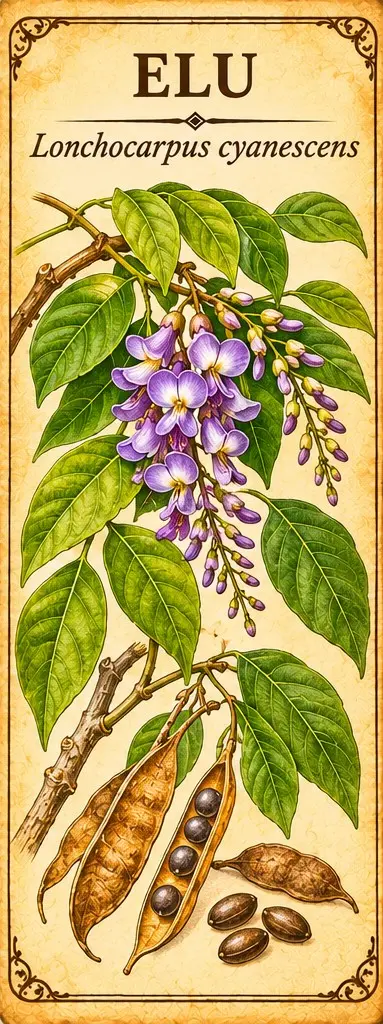
Elu
Lonchocarpus cyanescens
A West African plant whose leaves make an indigo dye. It's used in Nigerian traditional medicine for psychosis, and leaf extracts had antipsychotic-like effects in rodents.
Safety at a glance
- PregnancyNothing recorded
- BreastfeedingNothing recorded
- MedicinesNothing recorded
- Who should avoid itNothing recorded
- AllergiesNothing recorded
- Toxicity1 note →
Tap a box to read the safety notes below. “Nothing recorded” means our sources don't cover it, not that it's safe.
What is Elu?
- Plant family
- Fabaceae, the pea and bean family
- Parts used
- The leaves
- Where it grows
- West Africa
- Genus
- Lonchocarpus
- Species
- cyanescens
Traditionally used for
- Indigo dye
- Psychosis (traditional)
Traditionally described as
- Leaves yield a blue indigo dye
Traditions that use it
- African Traditional Medicine
Used in Nigerian traditional medicine, combined with other plants, for psychotic disorders.
Safety
Toxicity testing
The leaves contain cyanogenic glycosides, compounds that can release cyanide, along with cardiac glycosides. No human safety studies were found.[1]Study
What does the research say?
Traditional use
These are traditional uses, not proven treatments.
Laboratory & animal research
Lab and animal results show what might be worth studying in people. They don't show that the herb has these effects in humans.
In short
Contains cyanogenic and cardiac glycosides; no human safety studies.
Sources
- [1] Antipsychotic property of aqueous and ethanolic extracts of Lonchocarpus cyanescens (Schumach and Thonn.) Benth. (Fabaceae) in rodents · DOI: 10.1007/s11418-011-0562-6Peer-reviewed study
- [2] Staining characteristics of Lonchocarpus cyanescens leaf extract on the testis of Sprague-Dawley rats · DOI: 10.1017/S1431927612000505Peer-reviewed study
- [3] Antipsychotic property of solvent-partitioned fractions of Lonchocarpus cyanescens leaf extract in mice · DOI: 10.1515/jbcpp-2013-0065Peer-reviewed study
This information is educational and traditional in nature, and is not a substitute for professional medical advice. Unfamiliar word? See what these words mean.