
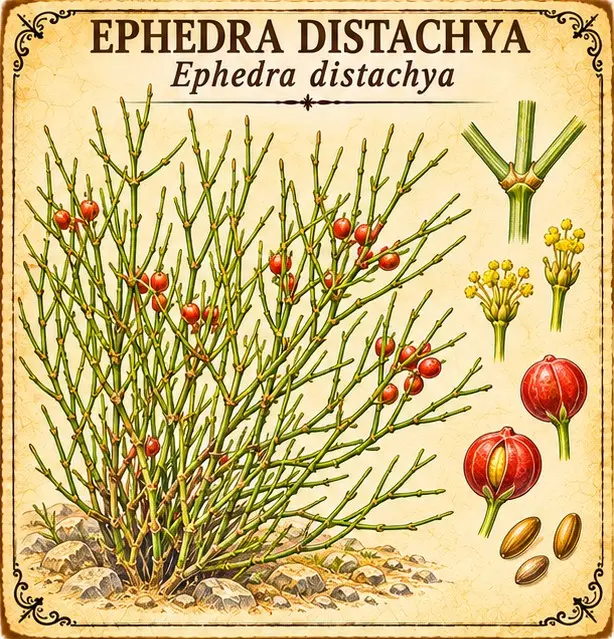
Ephedra Distachya
Ephedra distachya
A jointed, leafless shrub whose stems contain ephedrine, a stimulant. It's a Moroccan folk remedy for asthma and colds, but ephedrine supplements are banned in the US.
Safety at a glance
- PregnancyNothing recorded
- BreastfeedingNothing recorded
- MedicinesNothing recorded
- Who should avoid it1 note →
- AllergiesNothing recorded
- Toxicity1 note →
Tap a box to read the safety notes below. “Nothing recorded” means our sources don't cover it, not that it's safe.
What is Ephedra Distachya?
- Plant family
- Ephedraceae, the jointfir family
- Parts used
- The green stems
- Where it grows
- Southern Europe, North Africa and Central Asia
- Genus
- Ephedra
- Species
- distachya
Traditionally used for
- Asthma
- Colds (traditional)
Traditionally described as
- Contains ephedrine and pseudoephedrine
Health topics
Where Ephedra Distachya appears in symptom search, and why. Being listed doesn't mean it's a proven treatment.
- Asthma and Wheezing
A traditional Moroccan remedy for asthma. Ephedrine supplements are banned in the US.
Safety
Who should avoid it
In the US, dietary supplements containing ephedrine alkaloids are banned: the FDA found they present an unreasonable risk of illness or injury.[1]Health agency
Toxicity testing
Ephedrine is a stimulant whose effects vary with the amount and ratio of alkaloids in the plant, which differ widely between species and batches.[2]Study
What does the research say?
Traditional use
These are traditional uses, not proven treatments.
A low, jointed, nearly leafless shrub with red berry-like cones. In Morocco it's one of the Ephedra species used for colds, asthma and breathing problems, flu, diabetes, rheumatism and high blood pressure, and sometimes to control weight.[3]Study
Laboratory & animal research
Lab and animal results show what might be worth studying in people. They don't show that the herb has these effects in humans.
In short
Ephedrine-alkaloid supplements are banned by the FDA.
Sources
- [1] 21 CFR 119.1 Dietary supplements containing ephedrine alkaloids — US Food and Drug AdministrationGovernment health agency
- [2] Chemical composition of various Ephedra species · DOI: 10.17305/bjbms.2015.539Peer-reviewed study
- [3] Ethnobotanical Uses and Pharmacological Activities of Moroccan Ephedra Species · DOI: 10.1055/a-2269-2113Peer-reviewed study
- [4] Isolation and hypoglycemic activity of ephedrans A, B, C, D and E, glycans of Ephedra distachya herbs · DOI: 10.1055/s-2007-969437Peer-reviewed study
This information is educational and traditional in nature, and is not a substitute for professional medical advice. Unfamiliar word? See what these words mean.