
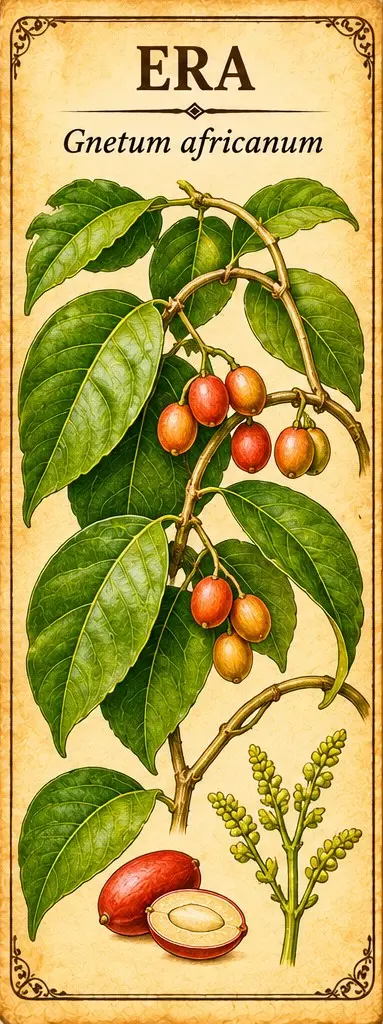
Era
Gnetum africanum
Eru, a wild plant whose leaves are one of the most widely eaten vegetables of Central and West Africa, cooked in soups.
Safety at a glance
- PregnancyNothing recorded
- BreastfeedingNothing recorded
- MedicinesNothing recorded
- Who should avoid itNothing recorded
- AllergiesNothing recorded
- ToxicityNothing recorded
Tap a box to read the safety notes below. “Nothing recorded” means our sources don't cover it, not that it's safe.
What is Era?
- Plant family
- Gnetaceae, the gnetum family
- Parts used
- The leaves
- Where it grows
- Central and West Africa
- Genus
- Gnetum
- Species
- africanum
Also called
Eru
Traditionally used for
- Leafy vegetable
- Obesity (traditional)
Traditionally described as
- Leaves rich in protein
- calcium
- iron and vitamin C
How it's prepared
Common ways Era is prepared or sold. This isn't advice on how to take it; see Safety below.
- Culinary Preparation
Leaves boiled in soups and side dishes.[1]Study
Safety
Depends on how it's prepared
Eaten as a cooked vegetable. No medical or safety studies were found.[1]Study
What does the research say?
Traditional use
These are traditional uses, not proven treatments.
Laboratory & animal research
Lab and animal results show what might be worth studying in people. They don't show that the herb has these effects in humans.
Congo Basin leafy vegetables including eru are nutrient-dense, with good amounts of protein, calcium, iron and vitamin C. In lab tests, eru extracts were rich in plant compounds and had the strongest germ-fighting effect of four African greens tested.[3]Review or trial
In short
No medical or safety studies were found.
Sources
- [1] Biochemical potential of four widely consumed African leafy vegetables · DOI: 10.1016/j.foodres.2026.119926Peer-reviewed study
- [2] An Ethnobotanical Survey and Pharmacological and Toxicity Review of Medicinal Plants Used in the Management of Obesity in the North Central Zone of Nigeria · DOI: 10.1155/jobe/5568216Peer-reviewed study
- [3] Nutritional, mineral, and bioactive composition of indigenous leafy vegetables from the Congo Basin: A systematic review and meta-analysis · DOI: 10.1016/j.foodres.2026.119410Review or clinical trial
This information is educational and traditional in nature, and is not a substitute for professional medical advice. Unfamiliar word? See what these words mean.