
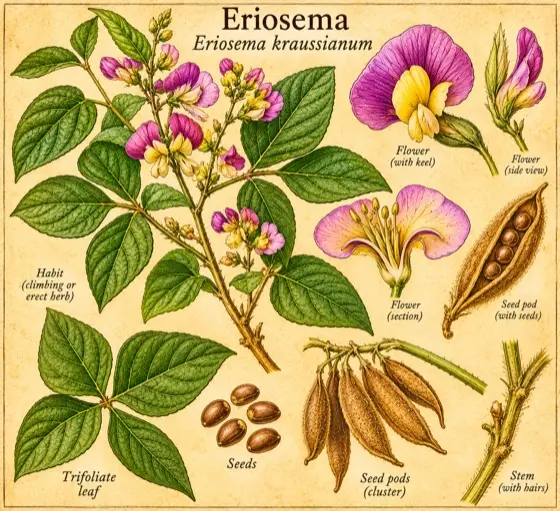
Eriosema
Eriosema kraussianum
A South African pea-family plant whose root, uBangalala, has been used by Zulu people for centuries to treat impotence (erectile dysfunction). A root compound relaxed rabbit penile tissue in the lab, but it has never been tested in people.
Safety at a glance
- PregnancyNothing recorded
- BreastfeedingNothing recorded
- MedicinesNothing recorded
- Who should avoid itNothing recorded
- AllergiesNothing recorded
- ToxicityNothing recorded
Tap a box to read the safety notes below. “Nothing recorded” means our sources don't cover it, not that it's safe.
What is Eriosema?
- Plant family
- Fabaceae, the pea and bean family
- Parts used
- The root (rootstock)
- Where it grows
- South Africa
- Genus
- Eriosema
- Species
- kraussianum
Traditional names
uBangalala
Older scientific names
Eriosema kraussianum
Traditionally used for
- Erectile dysfunction and impotence (traditional Zulu)
- Blood sugar (animal research)
Traditionally described as
- Root rich in pyrano-isoflavones (kraussianones)
Health topics
Where Eriosema appears in symptom search, and why. Being listed doesn't mean it's a proven treatment.
- Sexual Health
A Zulu remedy for impotence; a root compound relaxed rabbit penile tissue in the lab, but it hasn't been tested in men.
Traditions that use it
- African Traditional Medicine
Zulu people have used Eriosema roots (uBangalala) for centuries for impotence, taken as a hot milk infusion or boiled decoction.
Natural compounds
Safety
Side effects
There are no studies in people. How the body absorbs and handles Eriosema's compounds is unknown, and its safety, side effects and the conditions in which it shouldn't be used haven't been established.[1]Study
What does the research say?
Traditional use
These are traditional uses, not proven treatments.
Eriosema is a plant in the pea family from South Africa. For centuries, Zulu people have used the roots of Eriosema species to treat impotence (erectile dysfunction). Most of these species come under the Zulu umbrella name uBangalala.
The roots are taken as a hot milk infusion, or pounded and boiled, in small doses in the morning and at night. Traditional advice is to take it 2 to 4 hours before sex, with effects reported to last 4 to 6 hours.[1]Study
Eriosema is a genus of about 150 species found in tropical and subtropical regions of Africa, the Americas, Asia and Australia. At least 25 species are used in traditional medicine, and some are eaten as food.[2]Study
Laboratory & animal research
Lab and animal results show what might be worth studying in people. They don't show that the herb has these effects in humans.
In rats, two root compounds lowered blood sugar. In isolated rat blood vessels, they first briefly tightened and then relaxed the vessel walls for longer. Viagra, by contrast, only relaxed them and didn't lower blood sugar.[3]Study
Technical detail: compounds K1 and K2 at 20–80 mg/kg orally caused dose-dependent hypoglycaemia; at 100–2000 µg/mL they produced biphasic contraction-then-relaxation of rat portal veins.
In pregnant rats with a condition like pre-eclampsia (dangerously high blood pressure in pregnancy), one root compound reduced the rise in blood pressure and the number of pups that died. These are animal results only.[4]Study
Technical detail: kraussianone-2 in L-NAME-treated Sprague-Dawley rats; lowered soluble fms-like tyrosine kinase-1 (sFlt-1) and soluble endoglin.
Scientists isolated five compounds called pyrano-isoflavones from the root. In a lab test on rabbit penile tissue, the most active one had 75% of the activity of Viagra (sildenafil).[5]Study
Technical detail: structures confirmed by spectral data and single-crystal X-ray analysis; these compounds are known as kraussianones.
Across the Eriosema genus, lab and animal studies report many effects, including on sexual function, estrogen-like activity, bone loss, blood fats, blood sugar, diarrhea and germs. Some traditional uses are supported by these studies, but many haven't been tested.[2]Study
In short
Its safety and side effects in people are unknown.
Sources
- [1] African traditional medicines for erectile dysfunction: elusive dream or imminent reality?Peer-reviewed study
- [2] The Genus Eriosema (Fabaceae): From the Ethnopharmacology to an Evidence-Based Phytotherapeutic Perspective? · DOI: 10.3389/fphar.2021.641225Peer-reviewed study
- [3] Vasodilatory and hypoglycaemic effects of two pyrano-isoflavone extractives from Eriosema kraussianum N. E. Br. [Fabaceae] rootstock in experimental rat models · DOI: 10.1016/j.phytochem.2005.11.019Peer-reviewed study
- [4] The effect of Kraussianone-2 (Kr2), a natural pyrano-isoflavone from Eriosema kraussianum, in an L-NAME-induced pre-eclamptic rat model · DOI: 10.1002/ptr.3697Peer-reviewed study
- [5] Pyrano-isoflavones with erectile-dysfunction activity from Eriosema kraussianum · DOI: 10.1016/s0031-9422(02)00035-3Peer-reviewed study
This information is educational and traditional in nature, and is not a substitute for professional medical advice. Unfamiliar word? See what these words mean.