
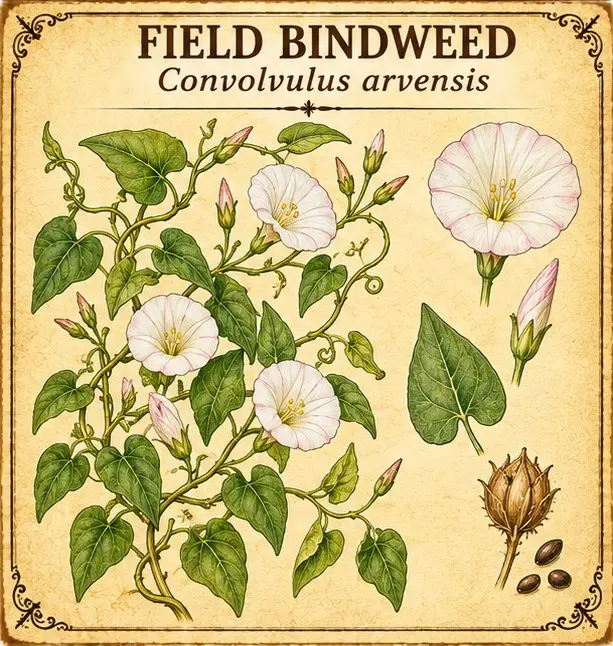
Field Bindweed
Convolvulus arvensis
A twining weed used in Pakistani traditional medicine as a laxative and on boils and rheumatism. It contains alkaloids that harmed horses and mice.
Safety at a glance
- PregnancyNothing recorded
- BreastfeedingNothing recorded
- MedicinesNothing recorded
- Who should avoid itNothing recorded
- AllergiesNothing recorded
- Toxicity2 notes →
Tap a box to read the safety notes below. “Nothing recorded” means our sources don't cover it, not that it's safe.
What is Field Bindweed?
- Plant family
- Convolvulaceae, the morning glory family
- Parts used
- The roots and leaves
- Where it grows
- Europe and Asia; now a weed worldwide
- Genus
- Convolvulus
- Species
- arvensis
Also called
Bindweed
Traditionally used for
- Laxative
- Boils
- Rheumatism (traditional)
Traditionally described as
- Contains tropane alkaloids
Safety
Toxicity testing
It contains tropane alkaloids. Horses grazing pastures overrun with bindweed lost weight and developed colic and scarring of the intestines.[1]Study
Mice fed only bindweed died within a week from severe liver damage and stomach ulcers; smaller amounts over weeks caused mild liver and stomach inflammation.[2]Study
What does the research say?
Traditional use
These are traditional uses, not proven treatments.
A twining weed with white or pink trumpet flowers. In Pakistani traditional medicine the roots are used as a laxative and a leaf paste is applied to boils, inflammation and rheumatism.[3]Study
It's been used in folk medicine for rheumatism, skin problems, infections, diabetes and digestive disorders.[4]Study
Laboratory & animal research
Lab and animal results show what might be worth studying in people. They don't show that the herb has these effects in humans.
In lab tests, extracts reduced inflammation in immune cells.[3]Study
In short
Contains toxic alkaloids; harmed horses and mice.
Sources
- [1] Tropane alkaloids and toxicity of Convolvulus arvensis · DOI: 10.1016/0031-9422(94)00969-zPeer-reviewed study
- [2] Toxicity of field bindweed (Convolvulus arvensis) to micePeer-reviewed study
- [3] Dereplication and Quantification of Major Compounds of Convolvulus arvensis L. Extracts and Assessment of Their Effect on LPS-Activated J774 Macrophages · DOI: 10.3390/molecules27030963Peer-reviewed study
- [4] Phytoconstituent analysis, anti-inflammatory, antimicrobial and anticancer effects of nano encapsulated Convolvulus arvensis L. extracts · DOI: 10.1186/s12906-024-04420-6Peer-reviewed study
This information is educational and traditional in nature, and is not a substitute for professional medical advice. Unfamiliar word? See what these words mean.