
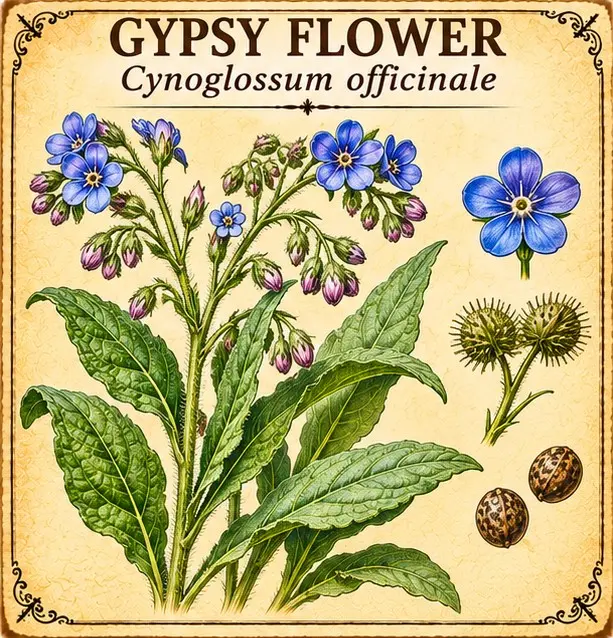
Gypsy Flower
Cynoglossum officinale
Hound's tongue, a hairy purple-flowered weed that's loaded with liver-destroying pyrrolizidine alkaloids. It has killed horses and calves that ate it.
Safety at a glance
- PregnancyNothing recorded
- BreastfeedingNothing recorded
- MedicinesNothing recorded
- Who should avoid itNothing recorded
- AllergiesNothing recorded
- Toxicity2 notes →
Tap a box to read the safety notes below. “Nothing recorded” means our sources don't cover it, not that it's safe.
What is Gypsy Flower?
- Plant family
- Boraginaceae, the borage family
- Parts used
- The leaves and roots
- Where it grows
- Europe and western Asia; now a weed in North America
- Genus
- Cynoglossum
- Species
- officinale
Also called
Hound's Tongue, Houndstongue, Gypsyflower
Traditionally used for
- None recommended (poisonous)
Traditionally described as
- Contains pyrrolizidine alkaloids
Safety
Toxicity testing
What does the research say?
Traditional use
These are traditional uses, not proven treatments.
A coarse, hairy biennial with purple-red flowers and burr-like seeds, also called hound's tongue. It's now a widespread weed in North American pastures.[1]Study
In short
Poisonous; contains liver-damaging pyrrolizidine alkaloids.
Sources
- [1] Cynoglossum officinale (hound's-tongue)--a cause of pyrrolizidine alkaloid poisoning in horsesPeer-reviewed study
- [2] Cynoglossum officinale toxicity in calves · DOI: 10.1016/s0021-9975(08)80150-8Peer-reviewed study
This information is educational and traditional in nature, and is not a substitute for professional medical advice. Unfamiliar word? See what these words mean.