
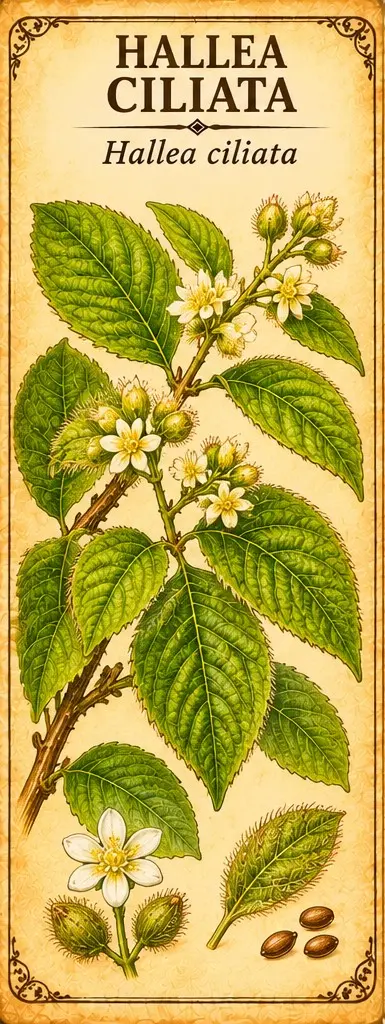
Hallea Ciliata
Mitragyna ciliata
A West and Central African tree, related to kratom, used for anxiety, fever and malaria. It has a digitalis-like effect on the heart in animal tests.
Safety at a glance
- PregnancyNothing recorded
- BreastfeedingNothing recorded
- MedicinesNothing recorded
- Who should avoid itNothing recorded
- AllergiesNothing recorded
- ToxicityNothing recorded
Tap a box to read the safety notes below. “Nothing recorded” means our sources don't cover it, not that it's safe.
What is Hallea Ciliata?
- Plant family
- Rubiaceae, the coffee family
- Parts used
- The stem bark, leaves and twigs
- Where it grows
- West and Central Africa
- Genus
- Mitragyna
- Species
- ciliata
Older scientific names
Mitragyna ciliata
Traditionally used for
- Anxiety
- Fever
- Malaria (traditional)
Traditionally described as
- Stem bark studied for calming and antimalarial effects
Health topics
Where Hallea Ciliata appears in symptom search, and why. Being listed doesn't mean it's a proven treatment.
Safety
Side effects
Its extract has a digitalis-like effect on the heart in animal tests, blocking the same heart enzyme that digoxin does. This could affect heart rhythm and interact with heart medicines.[1]Study
Depends on how it's prepared
It's in the same genus as kratom (Mitragyna speciosa), but no studies were found showing it has kratom's effects. No human safety studies were found.[2]Study
What does the research say?
Traditional use
These are traditional uses, not proven treatments.
In Cameroon a stem bark decoction is used for anxiety, fever, convulsions in children and malaria. In Ghana the leaves and twigs are used for fever.[2]Study
Laboratory & animal research
Lab and animal results show what might be worth studying in people. They don't show that the herb has these effects in humans.
In short
Has a digitalis-like effect on the heart in animal tests. No human safety studies were found.
Sources
- [1] Influence of Mitragyna ciliata (MYTA) on the microsomal activity of ATPase Na+/K+ dependent extract on a rabbit heart · DOI: 10.4314/ajtcam.v5i3.31286Peer-reviewed study
- [2] Anxiolytic-like properties of Hallea ciliata in mice · DOI: 10.21010/ajtcam.v13i4.1Peer-reviewed study
- [3] Antimalarial Efficacy and Toxicological Assessment of Extracts of Some Ghanaian Medicinal Plants · DOI: 10.1155/2019/1630405Peer-reviewed study
This information is educational and traditional in nature, and is not a substitute for professional medical advice. Unfamiliar word? See what these words mean.