
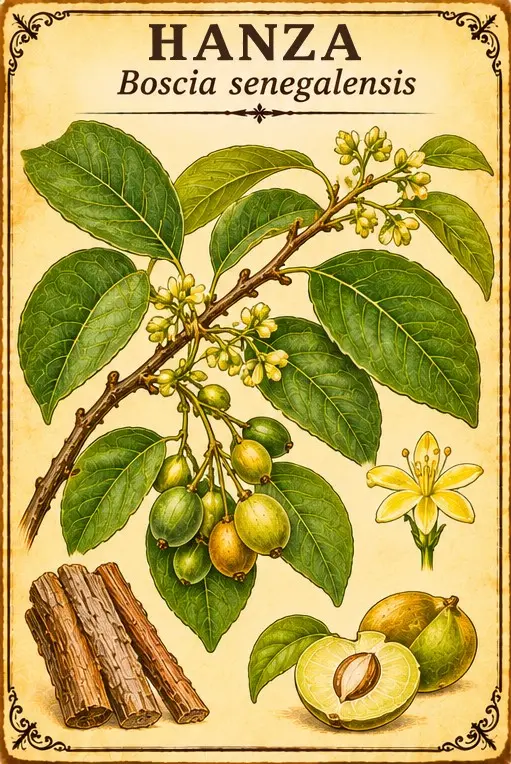
Hanza
Boscia senegalensis
A drought-hardy Sahel shrub whose bitter seeds, soaked for days, are a vital famine food. Healers use the seeds for high blood sugar, and a seed product lowered blood sugar in an uncontrolled diabetes study.
Safety at a glance
- PregnancyNothing recorded
- BreastfeedingNothing recorded
- MedicinesNothing recorded
- Who should avoid itNothing recorded
- AllergiesNothing recorded
- ToxicityNothing recorded
Tap a box to read the safety notes below. “Nothing recorded” means our sources don't cover it, not that it's safe.
What is Hanza?
- Plant family
- Capparaceae, the caper family
- Parts used
- The seeds, fruit and leaves
- Where it grows
- The Sahel region of Africa
- Genus
- Boscia
- Species
- senegalensis
Regional names
Mukheit
Traditionally used for
- Famine food
- Coffee substitute
- Diabetes (traditional)
Traditionally described as
- Seeds contain glucosinolates
Health topics
Where Hanza appears in symptom search, and why. Being listed doesn't mean it's a proven treatment.
- High Blood Sugar
A seed product lowered blood sugar in an uncontrolled 12-week diabetes study.
Safety
Depends on how it's prepared
The seeds contain bitter glucosinolates that are removed by days of soaking; unsoaked seeds aren't eaten. No serious side effects were reported in the diabetes study.[1]Study
What does the research say?
Traditional use
These are traditional uses, not proven treatments.
A drought-hardy Sahel shrub that's a vital famine food. Its seeds, called hanza or mukheit, are eaten across sub-Saharan Africa when crops fail; the berries fed people during the 1984-1985 Darfur famine.[2]Study
The fresh seeds taste bitter, so they're soaked in water for 4 to 7 days before eating. The fruit and seeds are also made into foods and a caffeine-free coffee substitute.[1]Study
Healers in the Sahel use the seeds to lower high blood sugar.[3]Study
Research in people
In a 12-week study of 332 people with type 2 diabetes, most not helped by diabetes pills, capsules of a seed product lowered blood sugar and HbA1c and increased sugar lost in the urine. There was no comparison group.[3]Study
In short
Seeds must be soaked for days to remove bitter compounds.
Sources
- [1] Allelopathic effects of glucosinolate breakdown products in Hanza [Boscia senegalensis (Pers.) Lam.] processing waste water · DOI: 10.3389/fpls.2015.00532Peer-reviewed study
- [2] Famine Foods: A Structured Narrative Review of Nutritional, Toxicological, Ecological, and Socio-Cultural Perspectives · DOI: 10.3390/foods15203602Peer-reviewed study
- [3] Boscisucrophage: A Natural SGLT1/2 Inhibitor From Boscia senegalensis for Managing Type 2 Diabetes · DOI: 10.1002/fsn3.71621Peer-reviewed study
This information is educational and traditional in nature, and is not a substitute for professional medical advice. Unfamiliar word? See what these words mean.