
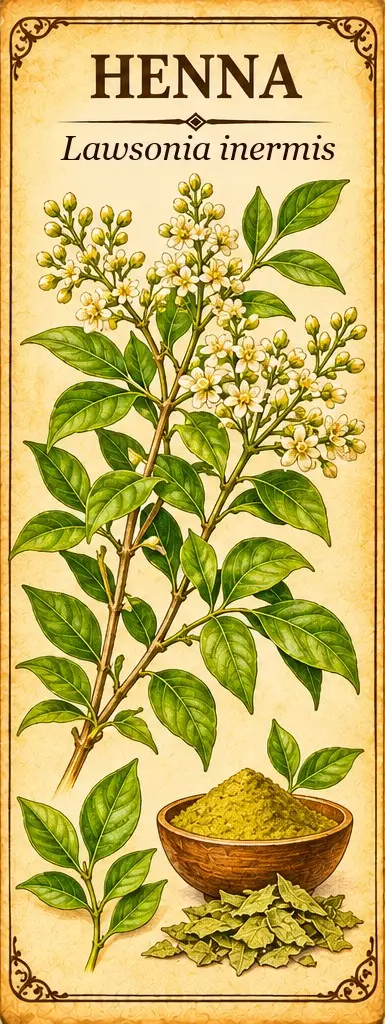
Henna
Lawsonia inermis
The plant dye used on hair, skin and nails for centuries. In the US it's approved only as a hair dye; "black henna" can cause dangerous skin reactions.
Safety at a glance
- Pregnancy1 note →
- BreastfeedingNothing recorded
- MedicinesNothing recorded
- Who should avoid it1 note →
- Allergies1 note →
- Toxicity1 note →
Tap a box to read the safety notes below. “Nothing recorded” means our sources don't cover it, not that it's safe.
What is Henna?
- Plant family
- Lythraceae, the loosestrife family, which includes pomegranate
- Parts used
- The leaves
- Where it grows
- North Africa, the Middle East and South Asia
- Genus
- Lawsonia
- Species
- inermis
Also called
Mehndi
Traditionally used for
- Hair dye
- Body art (mehndi)
Traditionally described as
- Leaves contain the dye lawsone
Natural compounds
Safety
Who should avoid it
Henna can trigger the breakdown of red blood cells (hemolysis) in people with G6PD deficiency, an inherited enzyme disorder. An 8-year-old girl in Ghana had severe hemolysis after henna was put on her skin.[1]Study
Allergies
Even pure henna can cause allergic skin reactions, from a local rash to an immediate severe reaction, in both adults and children.[2]Review or trial
Pregnancy
In pregnant mice, an injected leaf extract caused birth defects, including missing skull bones, and smaller embryos. It's traditionally described as able to cause miscarriage.[3]Study
Toxicity testing
A man with G6PD deficiency in Myanmar developed severe kidney injury needing dialysis after drinking boiled henna leaves. He recovered fully.[4]Study
Contamination
Tests of 12 commercial and traditional henna samples found low levels of lead. Repeated use over time, especially by children, may still be a concern.[5]Study
Depends on how it's prepared
In the US, henna is approved only as a hair dye, not for use on the skin. "Black henna" usually contains a hair dye chemical, p-phenylenediamine (PPD), that can cause dangerous skin reactions and scarring, and make you allergic to hair dyes.[6]Health agency
What does the research say?
Traditional use
These are traditional uses, not proven treatments.
Henna is a plant dye used for centuries on hair, skin and nails, including the body art known as mehndi, in Africa and Asia.[1]Study
In traditional medicine, especially Ayurveda, the leaves are used on wounds, ulcers, boils and scabies, and for headache, hair loss and jaundice. The bark has been used for jaundice and liver problems, and the flowers for sleeplessness.[7]Study
Laboratory & animal research
Lab and animal results show what might be worth studying in people. They don't show that the herb has these effects in humans.
Research in people
A 2026 review of 24 human studies found some results favoring henna for various conditions, but the evidence was low or very low quality and doesn't show it's reliably effective or safe. It shouldn't replace standard care.[9]Review or trial
In a trial of 80 intensive care patients, henna applied to the lower back along with standard care led to fewer pressure sores (1 patient versus 6).[10]Study
In short
Avoid black henna; can cause allergy, and hemolysis in people with G6PD deficiency.
Sources
- [1] Henna-Induced Intravascular Hemolysis in a Glucose-6-Phosphate Dehydrogenase-Deficient Ghanaian Female Child with Full Defect · DOI: 10.2147/IMCRJ.S534544Peer-reviewed study
- [2] Allergic Contact Dermatitis to Pure Henna: A Systematic Review · DOI: 10.1111/cod.70227Review or clinical trial
- [3] Antioxidant Activity and Teratogenicity Evaluation of Lawsonia Inermis in BALB/c Mice · DOI: 10.7860/JCDR/2015/12290.5911Peer-reviewed study
- [4] Acute Kidney Injury following Ingestion of Henna Leaf Extract: A Case Report from Myanmar · DOI: 10.1159/000479618Peer-reviewed study
- [5] Lead exposure from the use of Lawsonia inermis (henna) in temporary paint-on-tattooing and hair dying · DOI: 10.1016/j.scitotenv.2008.02.055Peer-reviewed study
- [6] Temporary Tattoos, Henna/Mehndi, and "Black Henna": Fact Sheet — US Food and Drug AdministrationGovernment health agency
- [7] Therapeutic potential of Lawsonia inermis Linn: a comprehensive overview · DOI: 10.1007/s00210-023-02735-8Peer-reviewed study
- [8] Anti-inflammatory, antipyretic, and analgesic effects of Lawsonia inermis L. (henna) in rats · DOI: 10.1159/000139347Peer-reviewed study
- [9] Clinical Efficacy and Safety of Lawsonia inermis (Henna): A Systematic Review of Human Clinical Studies · DOI: 10.1016/j.ctim.2026.103470Review or clinical trial
- [10] Henna (Lawsonia inermis) as an Inexpensive Method to Prevent Decubitus Ulcers in Critical Care Units: A Randomized Clinical Trial · DOI: 10.1177/2515690X18772807Peer-reviewed study
This information is educational and traditional in nature, and is not a substitute for professional medical advice. Unfamiliar word? See what these words mean.