
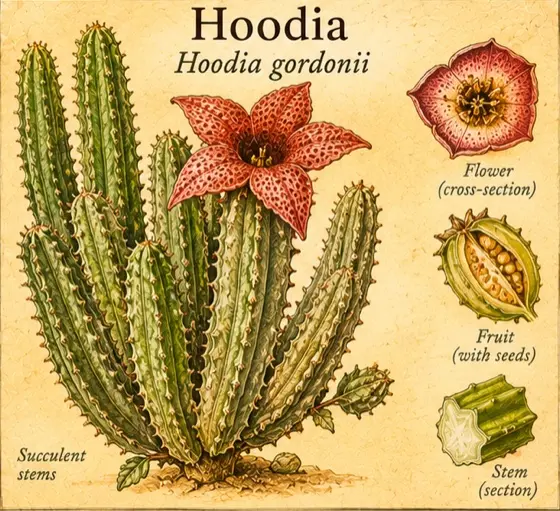
Hoodia
Hoodia gordonii
A spiny desert succulent used by the San and Khoe peoples as food, medicine and a source of water. Sold for weight loss, it didn't reduce eating or weight in a trial and caused side effects.
Safety at a glance
- PregnancyNothing recorded
- BreastfeedingNothing recorded
- MedicinesNothing recorded
- Who should avoid itNothing recorded
- AllergiesNothing recorded
- ToxicityNothing recorded
Tap a box to read the safety notes below. “Nothing recorded” means our sources don't cover it, not that it's safe.
What is Hoodia?
- Plant family
- Apocynaceae, the dogbane and milkweed family
- Parts used
- The fleshy stems
- Where it grows
- The Kalahari and Namib deserts of southern Africa
- Genus
- Hoodia
- Species
- gordonii
Also called
Bushman's Hat, Kalahari Cactus
Traditional names
Xhoba
Older scientific names
Hoodia gordonii
Traditionally used for
- Appetite suppression (traditional
- not supported by trials)
- Food and water source (traditional)
Traditionally described as
- Contains pregnane glycosides such as P57
Traditions that use it
- African Traditional Medicine
The San and Khoe peoples of southern Africa used hoodia as food, medicine and a source of water long before Europeans arrived.
Natural compounds
How it's prepared
Common ways Hoodia is prepared or sold. This isn't advice on how to take it; see Safety below.
Safety
Side effects
In the 15-day trial, hoodia was less well tolerated than placebo. Women taking it had:
- Nausea and vomiting
- Unusual skin sensations
- Rises in blood pressure, pulse and heart rate
- Changes in liver-related blood tests (bilirubin and alkaline phosphatase)
There were no serious side effects.[1]Study
A review found that hoodia extracts have a range of side effects, which question whether they're suitable to eat. It concluded that the weight loss seen may come partly from these side effects.[2]Study
What does the research say?
Traditional use
These are traditional uses, not proven treatments.
Hoodia is a spiny, cactus-like succulent from the deserts of southern Africa (it isn't a true cactus). The San and Khoe peoples used it as food, medicine and a source of water. A South African research body patented it without their consent and sold the rights to a drug company, raising questions about fair sharing of the benefits.[3]Study
Technical detail: patented by the South African Council for Scientific and Industrial Research (CSIR) and licensed to Phytopharm.
Laboratory & animal research
Lab and animal results show what might be worth studying in people. They don't show that the herb has these effects in humans.
Hoodia became famous worldwide as an appetite suppressant, but peer-reviewed studies of its effects are sparse. Much of the positive information comes from patents and advertising. A 2014 review concluded that any loss of appetite and weight may be partly a result of its serious side effects at the high doses needed.[2]Study
Technical detail: the pregnane glycoside P57, long assumed to cause appetite suppression, has been questioned; the review included new rodent data.
Research in people
In a 15-day trial, 49 overweight women living in a clinic took a hoodia extract or a placebo in a yogurt drink twice a day. Hoodia didn't reduce how much they ate or their body weight compared with the placebo. It also caused more side effects.[1]Study
Technical detail: purified extract (HgPE) 1,110 mg twice daily, 1 hour before breakfast and dinner; 25 hoodia vs 24 placebo; ad libitum intake from standardized menus.
In short
Caused nausea, vomiting, skin sensations and rises in blood pressure and heart rate in a trial.
Sources
- [1] Effects of 15-d repeated consumption of Hoodia gordonii purified extract on safety, ad libitum energy intake, and body weight in healthy, overweight women: a randomized controlled trial · DOI: 10.3945/ajcn.111.020321Peer-reviewed study
- [2] Hoodia gordonii: to eat, or not to eat · DOI: 10.1016/j.jep.2014.06.033Peer-reviewed study
- [3] Politics of biopiracy: an adventure into Hoodia/Xhoba patenting in Southern Africa · DOI: 10.21010/ajtcam.v14i1.11Peer-reviewed study
This information is educational and traditional in nature, and is not a substitute for professional medical advice. Unfamiliar word? See what these words mean.