
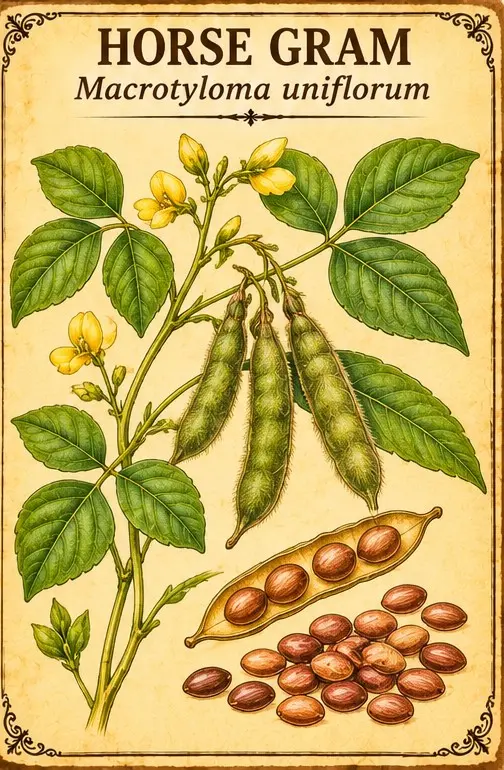
Horse Gram
Macrotyloma uniflorum
A hardy, protein-rich pulse used in Himalayan and Indian folk medicine for kidney stones. A seed extract reduced kidney stone crystals in rats.
Safety at a glance
- PregnancyNothing recorded
- BreastfeedingNothing recorded
- MedicinesNothing recorded
- Who should avoid itNothing recorded
- AllergiesNothing recorded
- ToxicityNothing recorded
Tap a box to read the safety notes below. “Nothing recorded” means our sources don't cover it, not that it's safe.
What is Horse Gram?
- Plant family
- Fabaceae, the pea and bean family
- Parts used
- The seeds (a pulse)
- Where it grows
- Tropical Africa and South Asia
- Genus
- Macrotyloma
- Species
- uniflorum
Also called
Horsegram
Regional names
Kulthi
Traditionally used for
- Food
- Kidney stones
- Asthma (traditional)
Traditionally described as
- High in protein
- fiber and polyphenols
Health topics
Where Horse Gram appears in symptom search, and why. Being listed doesn't mean it's a proven treatment.
- High Cholesterol
Lowered cholesterol in rats. Not tested in people.
- Kidney Stones
A traditional kidney stone remedy; a seed extract reduced stone crystals in rats. Not tested in people.
Safety
Depends on how it's prepared
It's eaten as a food, but no human medical studies were found.[1]Review or trial
What does the research say?
Traditional use
These are traditional uses, not proven treatments.
A hardy pulse rich in protein, fiber and minerals. Since ancient times it's been eaten and used as a remedy in the Himalayas for kidney and bladder stones, bronchitis, asthma, piles, skin patches (leukoderma) and heart disease.[1]Review or trial
Laboratory & animal research
Lab and animal results show what might be worth studying in people. They don't show that the herb has these effects in humans.
In rats with kidney stones, a seed extract increased urine, raised stone-blocking minerals and cut crystals in the urine.[2]Study
In rats on a high-fat diet, horse gram lowered blood sugar, cholesterol, triglycerides and body weight, and raised HDL cholesterol.[3]Study
In mice on a gallstone-causing diet, seed extracts cut gallstones by up to 60% and lowered cholesterol.[4]Study
In short
No human medical studies were found.
Sources
- [1] Traditional uses, phytochemistry, pharmacology, and nutraceutical potential of horse gram (Macrotyloma uniflorum): A systematic review · DOI: 10.1111/1750-3841.17594Review or clinical trial
- [2] Effect of Macrotyloma uniflorum in ethylene glycol induced urolithiasis in rats · DOI: 10.1016/j.heliyon.2020.e04253Peer-reviewed study
- [3] Macrotyloma uniflorum a plant food alleviates the metabolic syndrome through modulation of adipokines and PPARs · DOI: 10.1111/jfbc.13595Peer-reviewed study
- [4] The effect of Macrotyloma uniflorum seed on bile lithogenicity against diet induced cholelithiasis on mice · DOI: 10.4103/0257-7941.147433Peer-reviewed study
This information is educational and traditional in nature, and is not a substitute for professional medical advice. Unfamiliar word? See what these words mean.