
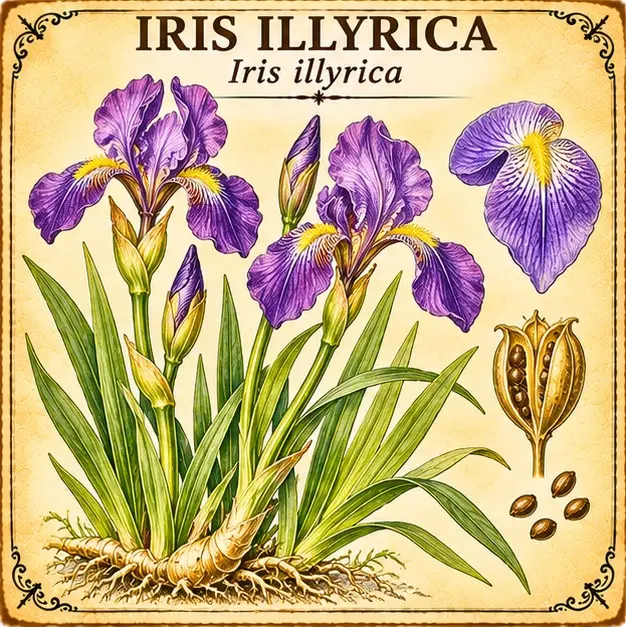
Iris Illyrica
Iris illyrica
An iris that grows wild only in Croatia. Aged iris rhizomes give scented oils used in perfume, cosmetics and food.
Safety at a glance
- PregnancyNothing recorded
- BreastfeedingNothing recorded
- MedicinesNothing recorded
- Who should avoid itNothing recorded
- AllergiesNothing recorded
- ToxicityNothing recorded
Tap a box to read the safety notes below. “Nothing recorded” means our sources don't cover it, not that it's safe.
What is Iris Illyrica?
- Plant family
- Iridaceae, the iris family
- Parts used
- The rhizomes
- Where it grows
- Croatia
- Genus
- Iris
- Species
- illyrica
Older scientific names
Iris pallida subsp. illyrica
Traditionally used for
- Fragrance
Traditionally described as
- Rhizome contains scent compounds
Safety
Depends on how it's prepared
There are no human safety studies.[1]Study
What does the research say?
Traditional use
These are traditional uses, not proven treatments.
An iris that grows wild only in Croatia. Aged iris rhizomes give essential oils used in medicine, cosmetics, perfume and food, mainly for their scent compounds called irones.[1]Study
Laboratory & animal research
Lab and animal results show what might be worth studying in people. They don't show that the herb has these effects in humans.
A chemical study mapped the scent compounds in its dried rhizomes. No health effects have been studied.[1]Study
In short
No human safety studies.
Sources
- [1] Gas Chromatography-Mass Spectrometry Analysis of Volatile Organic Compounds from Three Endemic Iris Taxa: Headspace Solid-Phase Microextraction vs. Hydrodistillation · DOI: 10.3390/molecules29174107Peer-reviewed study
This information is educational and traditional in nature, and is not a substitute for professional medical advice. Unfamiliar word? See what these words mean.