
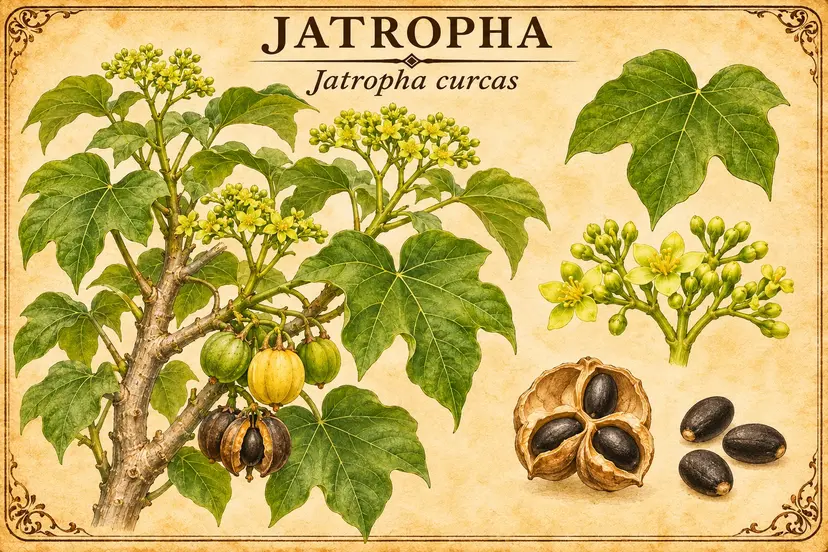
Jatropha
Jatropha curcas
Physic nut, a tropical shrub whose seeds are poisonous and a leading cause of plant poisoning in children. A non-toxic Mexican variety (xuta) is eaten roasted.
Safety at a glance
- PregnancyNothing recorded
- BreastfeedingNothing recorded
- MedicinesNothing recorded
- Who should avoid itNothing recorded
- AllergiesNothing recorded
- Toxicity3 notes →
Tap a box to read the safety notes below. “Nothing recorded” means our sources don't cover it, not that it's safe.
What is Jatropha?
- Plant family
- Euphorbiaceae, the spurge family
- Parts used
- The seeds (kernels) and their oil
- Where it grows
- Mexico and Central America
- Genus
- Jatropha
- Species
- curcas
Also called
Physic Nut, Barbados Nut
Regional names
Xuta
Traditionally used for
- Food (non-toxic variety only)
- Seed oil
Traditionally described as
- Seeds contain toxic phorbol esters
Health topics
Where Jatropha appears in symptom search, and why. Being listed doesn't mean it's a proven treatment.
- Poisonous Plants
The seeds are the most common plant poison eaten by children in some countries.
Natural compounds
Safety
Toxicity testing
A review of plant poisoning in children found eating jatropha seeds or fruit is an important cause of acute poisoning in several countries, including Sri Lanka, Thailand and France.[1]Review or trial
Toxic varieties contain high levels of phorbol esters, and toxic and non-toxic plants and kernels look exactly alike, so only lab testing can tell them apart.[2]Health agency
In a study of children poisoned by plants in rural Sri Lanka, jatropha was the most common cause, usually eaten in home gardens.[3]Study
What does the research say?
Traditional use
These are traditional uses, not proven treatments.
Most jatropha is toxic, but a non-toxic variety called xuta has been roasted and eaten in Mexico for over 25 years. In 2026 the European Food Safety Authority found roasted xuta kernels safe as a food, provided they're tested to keep out toxic kernels.[2]Health agency
In short
Seeds are poisonous; toxic and non-toxic kinds look alike.
Sources
- [1] Plant toxins and acute medicinal plant poisoning in children: A systematic literature review · DOI: 10.4103/jrms.JRMS_629_17Review or clinical trial
- [2] Safety of roasted and ground kernels of an edible variety of Jatropha curcas L. (Xuta) as a traditional food from a third country pursuant to Regulation (EU) No 2015/2283 — European Food Safety Authority (EFSA), Panel on Nutrition, Novel Foods and Food Allergens · DOI: 10.2903/j.efsa.2026.10389Government health agency
- [3] Plant Poisoning among Children in Rural Sri Lanka · DOI: 10.1155/2017/6187487Peer-reviewed study
This information is educational and traditional in nature, and is not a substitute for professional medical advice. Unfamiliar word? See what these words mean.