
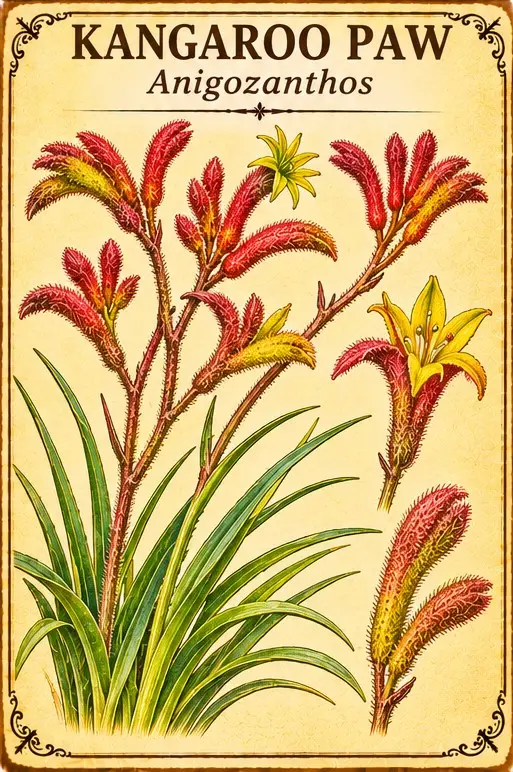
Kangaroo Paw
Anigozanthos spp.
Western Australian plants with fuzzy, paw-shaped flowers. The Noongar people eat the starchy roots, and extracts are used in anti-wrinkle creams; no published medicinal uses were found.
Safety at a glance
- PregnancyNothing recorded
- BreastfeedingNothing recorded
- MedicinesNothing recorded
- Who should avoid itNothing recorded
- AllergiesNothing recorded
- ToxicityNothing recorded
Tap a box to read the safety notes below. “Nothing recorded” means our sources don't cover it, not that it's safe.
What is Kangaroo Paw?
- Plant family
- Haemodoraceae, the bloodwort family, which includes kangaroo paws
- Parts used
- The flowers and leaves
- Where it grows
- Southwest Western Australia
- Genus
- Anigozanthos
- Species
- spp.
Also called
Catspaw
Regional names
Nollamara
Traditionally used for
- Food (roots
- Noongar)
- Ornamental
- Skin care
Traditionally described as
- Flowers contain flavonoids and anthocyanins
Safety
Depends on how it's prepared
No published medicinal uses or human safety studies were found.[1]Study
What does the research say?
Traditional use
These are traditional uses, not proven treatments.
Western Australian plants with fuzzy, claw-shaped flowers that look like a kangaroo's paw. The red-and-green kangaroo paw (Anigozanthos manglesii) is one well-known species. They're bird-pollinated and rich in nectar.[2]Study
Extracts of the big red kangaroo paw are used in anti-wrinkle creams by more than 30 skin care brands. The company that makes the ingredient says it boosts collagen and elastin in skin, but no independent studies have been published.[3]General reference
The Noongar people of southwest Western Australia eat the starchy, tuber-like roots of the red-and-green kangaroo paw, which they call nollamara.[4]General reference
All 11 species grow only in southwest Western Australia, and the red-and-green kangaroo paw is the state's floral emblem. Honeyeaters and the tiny honey possum feed on the nectar and pollinate the flowers.[4]General reference
Laboratory & animal research
Lab and animal results show what might be worth studying in people. They don't show that the herb has these effects in humans.
The nectar is mostly glucose and fructose, with small amounts of the amino acid tyrosine and other amino acids.[5]Study
The flowers contain flavonoids and red anthocyanin pigments. Tested against seven germs, including MRSA and Candida yeast, a few compounds had only weak activity against one bacterium, Acinetobacter baumannii.[1]Study
A leaf extract on its own had no effect against bacteria in lab tests; only silver particles made with it did.[2]Study
In short
No published medicinal uses or human safety studies were found.
Sources
- [1] Phytochemical Studies on Two Australian Anigozanthos Plant Species · DOI: 10.1021/acs.jnatprod.7b00063Peer-reviewed study
- [2] Biogenic synthesis of silver nanoparticles via indigenous Anigozanthos manglesii, (red and green kangaroo paw) leaf extract and its potential antibacterial activity · DOI: 10.18203/2320-6012.ijrms20162306Peer-reviewed study
- [3] Kangaroo paws used to fight wrinkles as demand booms for vegan cosmetics — ABC News (Australian Broadcasting Corporation)General reference
- [4] Plant 333: Anigozanthos species (Kangaroo paws) — University of Oxford, Department of Biology (Plants 400)General reference
- [5] NMR-based metabolic profiling of Anigozanthos floral nectar · DOI: 10.1021/np0705514Peer-reviewed study
This information is educational and traditional in nature, and is not a substitute for professional medical advice. Unfamiliar word? See what these words mean.