
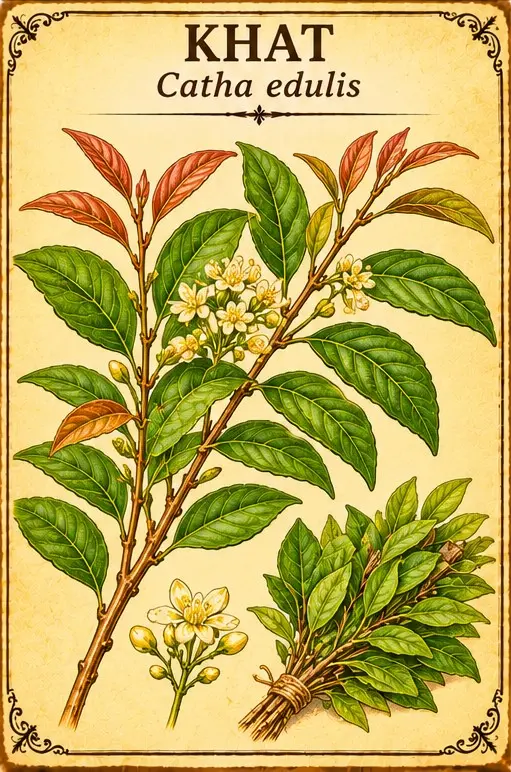
Khat
Catha edulis
A shrub whose leaves are chewed in East Africa and Yemen for an amphetamine-like high. Its main active compound is a Schedule I controlled substance in the US.
Safety at a glance
- PregnancyNothing recorded
- BreastfeedingNothing recorded
- MedicinesNothing recorded
- Who should avoid it1 note →
- AllergiesNothing recorded
- Toxicity1 note →
Tap a box to read the safety notes below. “Nothing recorded” means our sources don't cover it, not that it's safe.
What is Khat?
- Plant family
- Celastraceae, the staff-vine family
- Parts used
- The fresh leaves and twigs
- Where it grows
- East Africa and the Arabian Peninsula
- Genus
- Catha
- Species
- edulis
Also called
Qat, Abyssinian Tea
Regional names
Miraa
Traditionally used for
- Stimulant (chewed)
Traditionally described as
- Contains cathinone and cathine
Safety
Who should avoid it
In the US, khat's main active compound, cathinone, is a Schedule I controlled substance, and its other stimulant, cathine, is Schedule IV.[1]Health agency
Side effects
Khat raises blood pressure and heart rate right away. It can cause paranoia, hallucinations, nightmares, insomnia and stomach problems, and long-term use can lead to violence, suicidal depression and exhaustion.[2]Health agency
Long-term chewing is linked to white patches in the mouth, gum disease, tooth loss, dry mouth and brown-stained teeth.[3]Study
Toxicity testing
Liver damage and heart attacks have been reported, mostly in long-term chewers or after very large amounts. Six men who chewed khat developed hepatitis that looked like autoimmune hepatitis.[4]Study
What does the research say?
Traditional use
These are traditional uses, not proven treatments.
A shrub whose fresh leaves and twigs are chewed for their amphetamine-like stimulant effect, a habit common in East Africa and Yemen and recorded since at least the 11th century.[5]Study
In Ethiopia, about 1 in 5 people currently chew khat, and men are about four times as likely as women to use it.[6]Review or trial
In short
A US controlled substance; raises blood pressure and heart rate and can damage the liver.
Sources
- [1] 21 CFR 1308.11 Schedule I and 1308.14 Schedule IV — US Drug Enforcement Administration (Code of Federal Regulations)Government health agency
- [2] Khat: Drug Fact Sheet — US Drug Enforcement AdministrationGovernment health agency
- [3] Khat (Catha edulis) and its oral health effects: An updated review · DOI: 10.1111/jicd.12288Peer-reviewed study
- [4] Khat (Catha Edulis) as a possible cause of autoimmune hepatitis · DOI: 10.4254/wjh.v6.i3.150Peer-reviewed study
- [5] Khat (Catha edulis)-an updated review · DOI: 10.1080/13556210500353020Peer-reviewed study
- [6] Epidemiology of Khat (Catha edulis) Chewing in Ethiopia: A Systematic Review and meta-analysis · DOI: 10.1080/02791072.2022.2155735Review or clinical trial
This information is educational and traditional in nature, and is not a substitute for professional medical advice. Unfamiliar word? See what these words mean.