
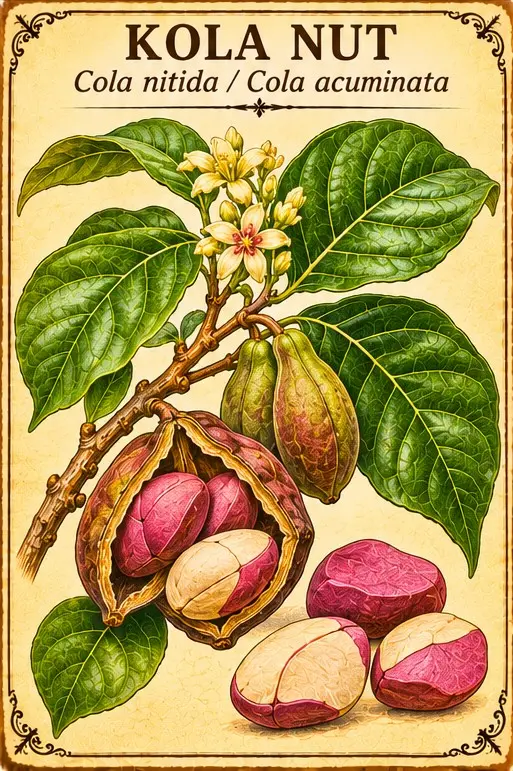
Kola Nut
Cola nitida
A bitter, caffeine-rich West African nut chewed for energy and shared as a sign of hospitality. It flavored the first colas.
Safety at a glance
- Pregnancy1 note →
- BreastfeedingNothing recorded
- MedicinesNothing recorded
- Who should avoid itNothing recorded
- AllergiesNothing recorded
- ToxicityNothing recorded
Tap a box to read the safety notes below. “Nothing recorded” means our sources don't cover it, not that it's safe.
What is Kola Nut?
- Plant family
- Malvaceae, the mallow family
- Parts used
- The seeds (nuts)
- Where it grows
- West Africa
- Genus
- Cola
- Species
- nitida
Also called
Cola Nut
Traditionally used for
- Stimulant
- Hospitality (traditional)
Traditionally described as
- High in caffeine and tannins
Safety
Pregnancy
In pregnant rats, repeated doses of kola nut disrupted brain development in their pups. It's also high in caffeine.[1]Study
Depends on how it's prepared
The FDA lists kola nut extracts as generally recognized as safe in foods and drinks.[2]Health agency
What does the research say?
Traditional use
These are traditional uses, not proven treatments.
A bitter, caffeine-rich nut native to West Africa, chewed by people of all faiths and backgrounds to stave off hunger and tiredness and shared as a sign of hospitality. An Arab physician recommended it for stomach complaints in the 12th century.[3]Study
It was an original flavor and stimulant in Victorian tonics and in the first Coca-Cola and Pepsi-Cola, sold as a brain tonic and for indigestion.[3]Study
Kola chewing is common among Nigerian teenagers: three-quarters of secondary school students surveyed in Osogbo had tried it, most starting by age 14.[4]Study
Laboratory & animal research
Lab and animal results show what might be worth studying in people. They don't show that the herb has these effects in humans.
In lab tests, a kola infusion, rich in caffeine, blocked starch-digesting enzymes and reduced oxidative damage to liver tissue.[5]Study
In short
High in caffeine; harmed fetal brain development in rats.
Sources
- [1] Kola nut from Cola nitida vent. Schott administered to pregnant rats induces histological alterations in pups' cerebellum · DOI: 10.1371/journal.pone.0247573Peer-reviewed study
- [2] 21 CFR 182.20: Essential oils, oleoresins (solvent-free), and natural extractives (including distillates) — US Food and Drug Administration (Code of Federal Regulations)Government health agency
- [3] Kola nut: so much more than just a nut · DOI: 10.1177/0141076813507708Peer-reviewed study
- [4] Prevalence and associated risk factors of Kola nut chewing among secondary school students in Osogbo, Nigeria · DOI: 10.4081/mi.2011.e6Peer-reviewed study
- [5] Caffeine-rich infusion from Cola nitida (kola nut) inhibits major carbohydrate catabolic enzymes; abates redox imbalance; and modulates oxidative dysregulated metabolic pathways and metabolites in Fe2+-induced hepatic toxicity · DOI: 10.1016/j.biopha.2017.11.120Peer-reviewed study
This information is educational and traditional in nature, and is not a substitute for professional medical advice. Unfamiliar word? See what these words mean.