
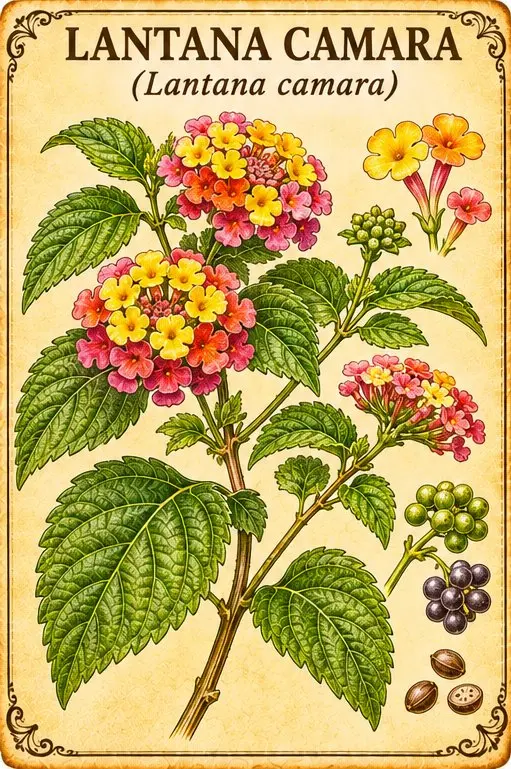
Lantana Camara
Lantana camara
A weedy garden shrub used in folk medicine. It poisons livestock, damaging the liver and kidneys.
Safety at a glance
- PregnancyNothing recorded
- BreastfeedingNothing recorded
- MedicinesNothing recorded
- Who should avoid itNothing recorded
- AllergiesNothing recorded
- Toxicity1 note →
Tap a box to read the safety notes below. “Nothing recorded” means our sources don't cover it, not that it's safe.
What is Lantana Camara?
- Plant family
- Verbenaceae, the verbena family
- Parts used
- The leaves and roots
- Genus
- Lantana
- Species
- camara
Traditionally used for
- Folk medicine
Traditionally described as
- Contains lantadenes
Health topics
Where Lantana Camara appears in symptom search, and why. Being listed doesn't mean it's a proven treatment.
- Cancer Research
Lab studies only: gold nanoparticles made with root extract killed breast cancer cells. Not tested against cancer in people. Lantana poisons livestock.
- Poisonous Plants
Poisons livestock, damaging the liver and kidneys.
Safety
Toxicity testing
Lantana poisons livestock every year. In cattle, sheep and buffalo it causes blocked bile flow with jaundice, skin sensitivity to sunlight, and damage mainly to the liver and kidneys.[1]Study
What does the research say?
Traditional use
These are traditional uses, not proven treatments.
Both a notorious weed and a popular garden plant, it has various uses in folk medicine in many parts of the world.[2]Study
Laboratory & animal research
Lab and animal results show what might be worth studying in people. They don't show that the herb has these effects in humans.
Gold nanoparticles made using lantana root extract killed breast cancer cells in the lab.[3]Study
In short
Toxic to livestock; liver and kidney damage.
Sources
- [1] A review of the toxicity of Lantana camara (Linn) in animals · DOI: 10.3109/15563658108990337Peer-reviewed study
- [2] Lantana camara L. (Verbenaceae) · DOI: 10.1016/s0367-326x(00)00202-1Peer-reviewed study
- [3] Recent advances in anticancer approach of traditional medicinal plants: A novel strategy for cancer chemotherapy · DOI: 10.1016/j.ipha.2024.02.001Peer-reviewed study
This information is educational and traditional in nature, and is not a substitute for professional medical advice. Unfamiliar word? See what these words mean.