
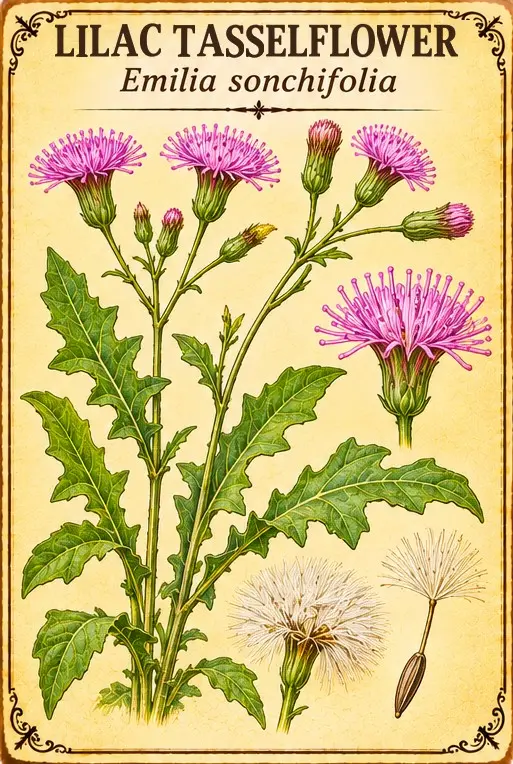
Lilac Tasselflower
Emilia sonchifolia
A small weedy daisy eaten as a vegetable and used in Chinese folk medicine for throat, chest and urinary infections. It contains a liver-damaging alkaloid, and extracts harmed the liver in mice.
Safety at a glance
- PregnancyNothing recorded
- BreastfeedingNothing recorded
- MedicinesNothing recorded
- Who should avoid itNothing recorded
- AllergiesNothing recorded
- Toxicity2 notes →
Tap a box to read the safety notes below. “Nothing recorded” means our sources don't cover it, not that it's safe.
What is Lilac Tasselflower?
- Plant family
- Asteraceae, the daisy family
- Parts used
- The whole plant
- Where it grows
- Tropical Asia and Africa; now a weed throughout the tropics
- Genus
- Emilia
- Species
- sonchifolia
Traditionally used for
- Throat and chest infections
- Mouth ulcers (traditional)
Traditionally described as
- Contains senkirkine
- a pyrrolizidine alkaloid
Health topics
Where Lilac Tasselflower appears in symptom search, and why. Being listed doesn't mean it's a proven treatment.
- Cancer Research
Lab studies only: an extract killed colon cancer cells. Not tested against cancer in people.
Safety
What does the research say?
Traditional use
These are traditional uses, not proven treatments.
A small weedy daisy with lilac tassel-like flowers, eaten as a vegetable and widely used in Chinese folk medicine for throat and chest infections, mouth ulcers, urinary infections, pneumonia, mastitis, gut infections and infected wounds.[1]Study
In Taiwan and China it's also used for inflammation, rheumatism, eye sores, convulsions, cough and cuts.[3]Study
Laboratory & animal research
Lab and animal results show what might be worth studying in people. They don't show that the herb has these effects in humans.
In short
Contains a liver-damaging pyrrolizidine alkaloid.
Sources
- [1] Combined metabolome and transcriptome to analyze the regulatory network of key enzymes in the synthesis of senkirkine in Emilia sonchifolia · DOI: 10.1186/s12870-025-07079-4Peer-reviewed study
- [2] Comprehensive multi-omics analysis reveals the mechanism of hepatotoxicity induced by Emilia sonchifolia (L.) DC. · DOI: 10.1016/j.jep.2025.119371Peer-reviewed study
- [3] Activations of Both Extrinsic and Intrinsic Pathways in HCT 116 Human Colorectal Cancer Cells Contribute to Apoptosis through p53-Mediated ATM/Fas Signaling by Emilia sonchifolia Extract, a Folklore Medicinal Plant · DOI: 10.1155/2012/178178Peer-reviewed study
- [4] Emilia sonchifolia (L.) DC. inhibits the growth of Methicillin-Resistant Staphylococcus epidermidis by modulating its physiology through multiple mechanisms · DOI: 10.1038/s41598-025-93561-wPeer-reviewed study
This information is educational and traditional in nature, and is not a substitute for professional medical advice. Unfamiliar word? See what these words mean.