
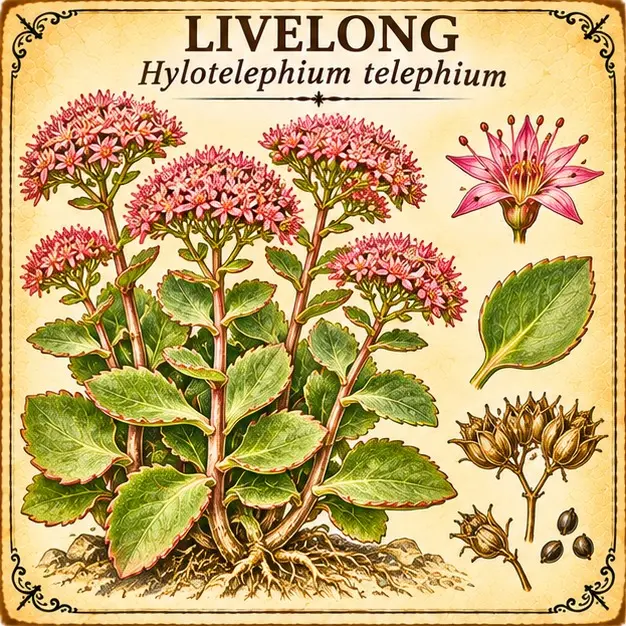
Livelong
Hylotelephium telephium
A succulent whose fresh leaf juice is used in Italian folk medicine on cold sores, burns, warts and wounds.
Safety at a glance
- PregnancyNothing recorded
- BreastfeedingNothing recorded
- MedicinesNothing recorded
- Who should avoid itNothing recorded
- AllergiesNothing recorded
- ToxicityNothing recorded
Tap a box to read the safety notes below. “Nothing recorded” means our sources don't cover it, not that it's safe.
What is Livelong?
- Plant family
- Crassulaceae, the stonecrop and jade plant family
- Parts used
- The fresh leaves
- Genus
- Hylotelephium
- Species
- telephium
Also called
Witch's Moneybags
Older scientific names
Sedum telephium
Traditionally used for
- Cold sores
- Burns
- Wounds
- Warts
Traditionally described as
- Rich in kaempferol and quercetin
Safety
Depends on how it's prepared
There are no human safety studies.[1]Study
What does the research say?
Traditional use
These are traditional uses, not proven treatments.
A succulent used in Italian folk medicine. Fresh leaves or their juice are put on burns, warts, wounds and other local inflammation, and the juice is used on cold sores.[2]Study
Laboratory & animal research
Lab and animal results show what might be worth studying in people. They don't show that the herb has these effects in humans.
In lab tests, the leaf juice didn't kill the cold sore virus, but it helped skin cells survive and calmed immune cells. This may explain why it seems to help cold sores.[1]Study
In lab tests, juices from the plant and its cell cultures eased inflammation and helped close wounds in a cell model. They're rich in kaempferol and quercetin.[2]Study
In short
No human safety studies.
Sources
- [1] Hylotelephium telephium (L) H. Ohba leaves juice improves herpetic lesions: new findings from in vitro investigations · DOI: 10.1080/14786419.2024.2423378Peer-reviewed study
- [2] From Ethnobotany to Biotechnology: Wound Healing and Anti-Inflammatory Properties of Sedum telephium L. In Vitro Cultures · DOI: 10.3390/molecules29112472Peer-reviewed study
This information is educational and traditional in nature, and is not a substitute for professional medical advice. Unfamiliar word? See what these words mean.