
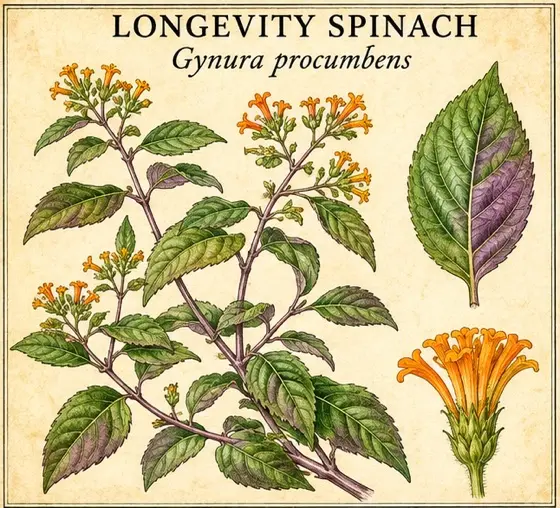
Longevity Spinach
Gynura procumbens
A leafy Southeast Asian herb traditionally used for high blood pressure, diabetes and kidney problems. Animal studies show it lowers blood sugar, but there are no human trials.
Safety at a glance
- PregnancyNothing recorded
- BreastfeedingNothing recorded
- Medicines1 note →
- Who should avoid itNothing recorded
- AllergiesNothing recorded
- ToxicityNothing recorded
Tap a box to read the safety notes below. “Nothing recorded” means our sources don't cover it, not that it's safe.
Longevity Spinach may interact with some medicines. If you take any medicine, read Interactions with medicines below and talk to your doctor or pharmacist before using it.
What is Longevity Spinach?
- Plant family
- Asteraceae, the daisy family
- Parts used
- The leaves (also the stems)
- Where it grows
- Tropical East and Southeast Asia
- Genus
- Gynura
- Species
- procumbens
Also called
Gynura
Traditional names
Sambung Nyawa
Traditionally used for
- Diabetes (traditional and animal research)
- High blood pressure (traditional)
- Kidney problems (traditional)
Traditionally described as
- Leaves rich in flavonoids such as kaempferol and quercetin
Health topics
Where Longevity Spinach appears in symptom search, and why. Being listed doesn't mean it's a proven treatment.
- High Blood Pressure
Traditionally used for high blood pressure; relaxed blood vessels in lab studies.
- High Blood Sugar
Lowered blood sugar in animal studies; no human trials.
- High Cholesterol
Improved blood fats in animal studies.
Natural compounds
Safety
Interactions with medicines
It lowered blood sugar in animal studies. Whether it adds to the effect of diabetes medicines in people hasn't been studied.[1]Study
Side effects
Of the six plants reviewed, longevity spinach had the most favorable short-term safety. Long-term safety, effects on reproduction and possible DNA damage haven't been well studied.[2]Review or trial
What does the research say?
Traditional use
These are traditional uses, not proven treatments.
Longevity spinach is a leafy plant of the daisy family from tropical East and Southeast Asia. It's traditionally used for:
- High blood pressure
- Diabetes
- Kidney problems
- Constipation
- Inflammation
Laboratory & animal research
Lab and animal results show what might be worth studying in people. They don't show that the herb has these effects in humans.
The leaves are rich in flavonoids such as kaempferol, quercetin, astragalin, myricetin and rutin. In lab and animal studies, they lowered blood sugar and blood pressure, and acted against germs, cancer cells and cell damage. Early studies also suggest a possible role in fertility.[3]Study
A 2025 review of 4 lab and 12 animal studies found that longevity spinach extracts lowered blood sugar and improved blood fats. Some studies found effects similar to the diabetes drug metformin, but results were mixed. There are no clinical studies in people.[1]Study
Technical detail: extract doses 50–3,000 mg; mixed results attributed to lack of extract standardization and unclear active compounds.
A 2026 review of six Indonesian plants used for heart and metabolic problems found that longevity spinach had the broadest range of effects. These included lowering blood sugar, improving blood fats, relaxing blood vessels and reducing inflammation. Most of this evidence comes from lab and animal studies.[2]Review or trial
In short
Short-term safety looks favorable; long-term safety is unknown.
Sources
- [1] Antidiabetic potential of Gynura procumbens (Lour.) Merr.: a review of in vitro and in vivo studies · DOI: 10.3389/fphar.2025.1646591Peer-reviewed study
- [2] Multitarget Pharmacological Mechanisms and Safety Profiles of Six Ethnobotanically Prioritized Indonesian Medicinal Plants for Cardiometabolic Disorders: A Systematic Review · DOI: 10.2147/DDDT.S630547Review or clinical trial
- [3] Pharmacological Overview of Bioactive Natural Products from Gynura procumbens (Lour.) Merr. · DOI: 10.3390/plants14172714Peer-reviewed study
This information is educational and traditional in nature, and is not a substitute for professional medical advice. Unfamiliar word? See what these words mean.