
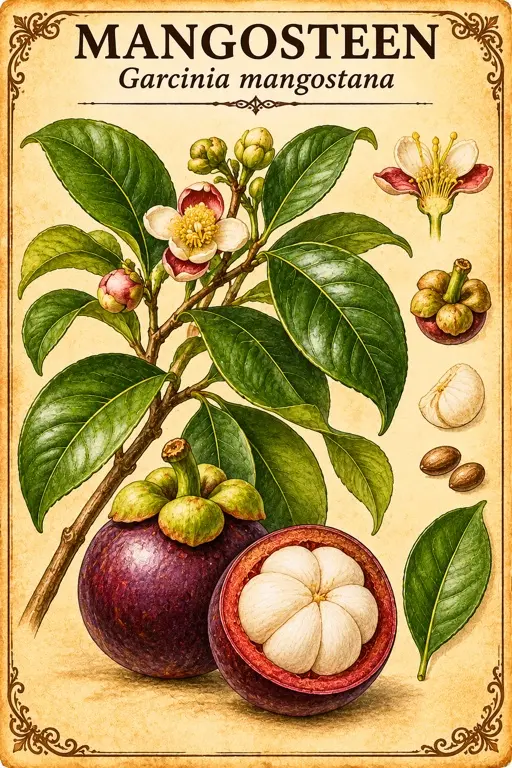
Mangosteen
Garcinia mangostana
A Southeast Asian fruit with a thick purple rind and sweet white segments, called the queen of fruits. Its rind, rich in xanthones, has been tested for gum disease, diabetes and bipolar depression, but Europe couldn't establish that rind extracts are safe.
Safety at a glance
- PregnancyNothing recorded
- BreastfeedingNothing recorded
- MedicinesNothing recorded
- Who should avoid itNothing recorded
- AllergiesNothing recorded
- Toxicity1 note →
Tap a box to read the safety notes below. “Nothing recorded” means our sources don't cover it, not that it's safe.
What is Mangosteen?
- Plant family
- Clusiaceae, the mangosteen family
- Parts used
- The fruit (eaten fresh); the thick purple rind (pericarp) in extracts
- Where it grows
- Southeast Asia
- Genus
- Garcinia
- Species
- mangostana
Also called
Purple Mangosteen, Queen of Fruits
Regional names
Manggis, Mangkhut
Traditionally used for
- Fruit
- Gum disease (gel)
- Inflammation (traditional)
- Blood sugar (early research)
Traditionally described as
- Rind rich in xanthones such as alpha-mangostin
Health topics
Where Mangosteen appears in symptom search, and why. Being listed doesn't mean it's a proven treatment.
- High Blood Sugar
Two small studies in type 2 diabetes suggested benefit from rind extract; evidence is very limited, and Europe couldn't establish the extract's safety.
- Liver Safety Warnings
A concentrated rind extract showed signs of liver and kidney damage in rats, and Europe couldn't establish its safety.
Natural compounds
Safety
Toxicity testing
In 2026, Europe's food safety agency concluded that the safety of a mangosteen rind extract for supplements can't be established. In a rat study, it showed signs of liver damage even at the lowest dose, and signs of kidney damage at higher doses. A safe dose couldn't be set, and possible damage to genes couldn't be ruled out.
This is about concentrated rind extracts, not the fresh fruit.[1]Health agency
Technical detail: hydro-alcoholic peel extract standardised to 44–52% total xanthones (26–34% α-mangostin), proposed at up to 200 mg/day. Raised ALT and bilirubin at the lowest dose; raised urea and BUN from the mid dose; lower body weight gain in all treated groups.
What does the research say?
Traditional use
These are traditional uses, not proven treatments.
Mangosteen is a tropical fruit tree from Southeast Asia, often called the "queen of fruits". The rind has long been used in traditional Southeast Asian medicine for conditions involving inflammation.[2]Study
Laboratory & animal research
Lab and animal results show what might be worth studying in people. They don't show that the herb has these effects in humans.
A 2025 review of 23 studies found that mangosteen extracts and compounds, such as alpha-mangostin, killed or slowed bacteria in lab and animal tests. These included drug-resistant germs such as MRSA.[3]Study
Technical detail: activity reported against methicillin-resistant Staphylococcus aureus and vancomycin-resistant Enterococcus species, in vitro and in vivo.
Research in people
A 2025 review pooled trials in which a mangosteen gel was placed into the gum pockets of adults with gum disease (periodontitis). Compared with a placebo or usual care, the gel made the pockets shallower and helped the gums reattach to the teeth.[4]Review or trial
Technical detail: local drug delivery; periodontal pocket depth effect size −1.08 (95% CI −1.40 to −0.77); clinical attachment level −0.96 (95% CI −1.80 to −0.13).
In a 24-week trial with 152 adults with bipolar depression, a mangosteen rind extract was added to their usual treatment. Overall, depression didn't improve more than with a placebo. Mood, overall illness severity and social functioning were better at 24 weeks, but the gains faded after stopping. The authors say the results need repeating.[5]Study
Technical detail: randomized, double-blind, placebo-controlled (ACTRN12616000028404); 70 mangosteen vs 82 placebo, 114 analysed; no effect on manic symptoms or quality of life.
A 2026 review found only 2 small studies of mangosteen rind extract in people with type 2 diabetes. One trial found better insulin sensitivity after 26 weeks, and a short study found lower fasting blood sugar after 7 days. Larger trials are needed.[6]Review or trial
Technical detail: HOMA-IR −53.2% vs −15.2% (p = 0.004) in a randomized pilot trial; fasting glucose fell after 7 days of mangosteen peel decoction in a quasi-experimental study.
In short
A concentrated rind extract showed signs of liver and kidney damage in rats; Europe couldn't establish a safe dose.
Sources
- [1] Safety of Garcinia mangostana L. (mangosteen) peel extract as a novel food pursuant to Regulation (EU) 2015/2283 — European Food Safety Authority (EFSA) Panel on Nutrition, Novel Foods and Food Allergens · DOI: 10.2903/j.efsa.2026.10393Government health agency
- [2] Insights into Bioactive Constituents from Pericarp of Garcinia mangostana: Anti-Inflammatory Effects via NF-κB/MAPK Modulation and M1/M2 Macrophage Polarization · DOI: 10.3390/antiox15010128Peer-reviewed study
- [3] Recent evidence on prominent anti-bacterial capacities of compounds derived from the mangosteen fruit · DOI: 10.1556/1886.2025.00006Peer-reviewed study
- [4] Efficacy of mangosteen as local drug delivery for improving periodontal health in adults with periodontitis: a systematic review and meta-analysis of randomized controlled trials · DOI: 10.1515/jcim-2024-0463Review or clinical trial
- [5] The efficacy of adjunctive Garcinia mangostana Linn. (mangosteen) pericarp extract for bipolar depression: 24-week randomised controlled trial · DOI: 10.1192/bjp.2025.108Peer-reviewed study
- [6] Effects of Garcinia mangostana Peel Extract on Glycemic Control in Type 2 Diabetes Mellitus: A Systematic Review of Human StudiesReview or clinical trial
This information is educational and traditional in nature, and is not a substitute for professional medical advice. Unfamiliar word? See what these words mean.