
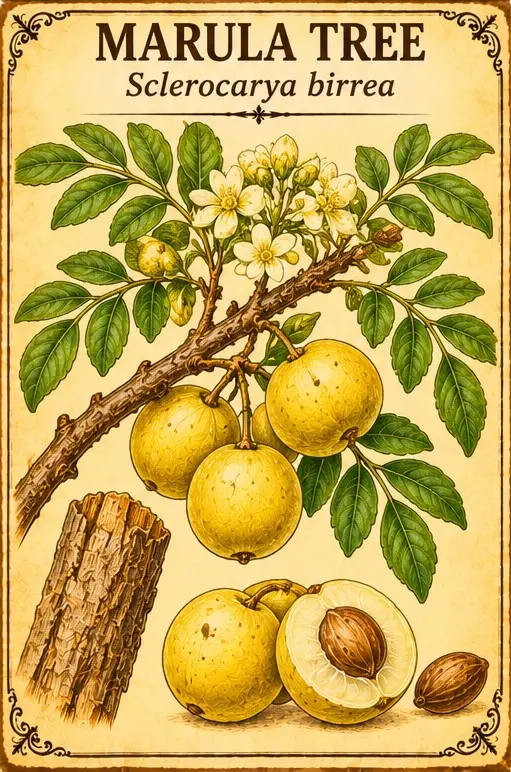
Marula Tree
Sclerocarya birrea
A prized southern African fruit tree; the fruit flavors Amarula liqueur and the nut oil moisturizes skin. The bark is a traditional diabetes remedy.
Safety at a glance
- PregnancyNothing recorded
- BreastfeedingNothing recorded
- MedicinesNothing recorded
- Who should avoid itNothing recorded
- AllergiesNothing recorded
- Toxicity1 note →
Tap a box to read the safety notes below. “Nothing recorded” means our sources don't cover it, not that it's safe.
What is Marula Tree?
- Plant family
- Anacardiaceae, the cashew and mango family
- Parts used
- The fruit, nut oil, bark and leaves
- Where it grows
- Southern, East and West Africa
- Genus
- Sclerocarya
- Species
- birrea
Also called
Marula
Traditionally used for
- Food
- Skin care
- Diabetes (traditional)
Traditionally described as
- Fruit high in vitamin C; nut oil rich in oleic acid
Health topics
Where Marula Tree appears in symptom search, and why. Being listed doesn't mean it's a proven treatment.
- Dry Skin
Marula oil moisturized dry skin in a small study.
- High Blood Sugar
A traditional diabetes remedy; lowered blood sugar in animal studies. Not tested in people.
Safety
Toxicity testing
In rats, a leaf extract caused no deaths at a very high single dose and no harm to organs or blood after 90 days of use.[1]Study
What does the research say?
Traditional use
These are traditional uses, not proven treatments.
One of southern Africa's most valued native trees. Its fruit pulp has more vitamin C than oranges and is made into sweets, wine and Amarula liqueur, and the nuts are eaten.[2]Study
The bark, fruit and leaves are used in African traditional medicine, especially for diabetes, and also for diarrhea and other ailments.[1]Study
Zulu people in South Africa have applied the nut oil to keep skin healthy, and it's now a popular cosmetic ingredient.[3]Study
Laboratory & animal research
Lab and animal results show what might be worth studying in people. They don't show that the herb has these effects in humans.
Animal and lab studies suggest it may lower blood sugar, ease diarrhea and inflammation, and fight germs.[4]Study
Research in people
In skin tests on 20 women, marula oil didn't irritate the skin and moisturized and hydrated dry skin.[3]Study
In short
A leaf extract showed no toxicity in rats.
Sources
- [1] Acute and Chronic Oral Toxicity of Hydroethanolic Extract of Sclerocarya birrea (Anacardiaceae) in Wistar Rats · DOI: 10.2147/JEP.S467920Peer-reviewed study
- [2] Marula [Sclerocarya birrea (A. Rich.) Hochst.] products as a food and medicine · DOI: 10.3389/fphar.2025.1552355Peer-reviewed study
- [3] Safety and efficacy of Sclerocarya birrea (A.Rich.) Hochst (Marula) oil: A clinical perspective · DOI: 10.1016/j.jep.2015.10.037Peer-reviewed study
- [4] Sclerocarya birrea (A. Rich) Hochst. ['Marula'] (Anacardiaceae): a review of its phytochemistry, pharmacology and toxicology and its ethnomedicinal uses · DOI: 10.1002/ptr.3080Peer-reviewed study
This information is educational and traditional in nature, and is not a substitute for professional medical advice. Unfamiliar word? See what these words mean.