
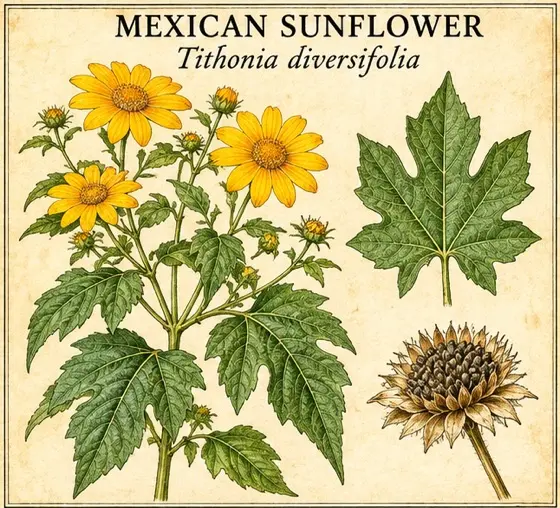
Mexican Sunflower
Tithonia diversifolia
A tall, yellow-flowered daisy-family plant from Mexico, now invasive across the tropics. It's used for diabetes in Indonesia, but studies show possible liver, kidney or reproductive toxicity.
Safety at a glance
- PregnancyNothing recorded
- BreastfeedingNothing recorded
- MedicinesNothing recorded
- Who should avoid itNothing recorded
- AllergiesNothing recorded
- Toxicity2 notes →
Tap a box to read the safety notes below. “Nothing recorded” means our sources don't cover it, not that it's safe.
What is Mexican Sunflower?
- Plant family
- Asteraceae, the daisy family
- Parts used
- The leaves and flowers
- Where it grows
- Mexico and Central America; now widespread and invasive in the tropics of Africa and Asia
- Genus
- Tithonia
- Species
- diversifolia
Also called
Tree Marigold, Japanese Sunflower, Tithonia
Traditional names
Kembang Bulan
Traditionally used for
- Diabetes (traditional and lab research)
- Inflammation and malaria (lab research)
Traditionally described as
- Rich in sesquiterpene lactones
Health topics
Where Mexican Sunflower appears in symptom search, and why. Being listed doesn't mean it's a proven treatment.
- High Blood Sugar
Used in Indonesia for diabetes; blocked sugar-digesting enzymes in lab tests, but with toxicity signals.
- Liver Safety Warnings
Studies have shown possible liver, kidney or reproductive toxicity.
Natural compounds
Safety
Toxicity testing
A 2026 review found that Mexican sunflower's strong effects on blood sugar in lab studies came with signs of possible harm to the liver, kidneys or reproduction in some studies. This may limit its use as a medicine.[1]Review or trial
Toxicity studies have been done, but how its compounds' effects relate to their toxicity remains unclear.[2]Study
What does the research say?
Traditional use
These are traditional uses, not proven treatments.
Mexican sunflower is a tall, shrubby plant of the daisy family with bright yellow-orange flowers. It's native to Mexico and Central America but has spread widely and become invasive in many tropical countries. In Indonesia, it's one of the plants traditionally used for heart and metabolic problems such as diabetes.[1]Review or trial
Laboratory & animal research
Lab and animal results show what might be worth studying in people. They don't show that the herb has these effects in humans.
About 150 compounds have been found in Mexican sunflower, especially sesquiterpene lactones (bitter compounds common in the daisy family). In lab and animal studies, extracts reduced inflammation, pain, diarrhea and spasms. They also acted against malaria, viruses, germs and diabetes, and repelled insects. Most studies used crude extracts rather than single compounds.[2]Study
In lab tests, extracts of the leaves and flowers acted as antioxidants, slowed the growth of several cancer cell types and blocked enzymes that digest starch and sugar. Flowers were the stronger antioxidant; leaves blocked the sugar enzymes slightly better.[3]Study
Technical detail: α-amylase IC50 38.99 µg/mL and α-glucosidase 49.62 µg/mL (leaves); liver, colon, breast and lung cancer cell lines.
In short
Possible liver, kidney and reproductive toxicity in studies.
Sources
- [1] Multitarget Pharmacological Mechanisms and Safety Profiles of Six Ethnobotanically Prioritized Indonesian Medicinal Plants for Cardiometabolic Disorders: A Systematic Review · DOI: 10.2147/DDDT.S630547Review or clinical trial
- [2] Ethnobotany, chemistry, and biological activities of the genus Tithonia (Asteraceae) · DOI: 10.1002/cbdv.201100019Peer-reviewed study
- [3] Bioactive Potential of Tithonia diversifolia: Phytochemical Profiling and Multifunctional Activities · DOI: 10.1002/cbdv.202502969Peer-reviewed study
This information is educational and traditional in nature, and is not a substitute for professional medical advice. Unfamiliar word? See what these words mean.