
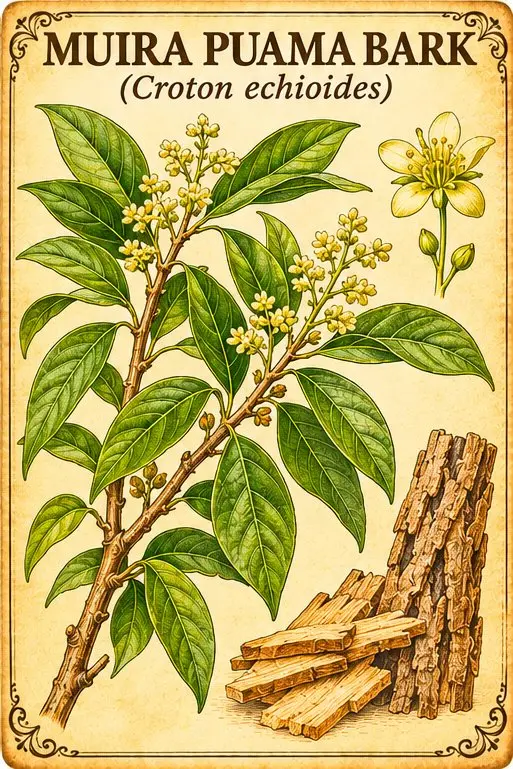
Muira Puama Bark
Croton echioides
A Brazilian bark used as a substitute for true muira puama (Ptychopetalum). Research on this plant is lab-only.
Safety at a glance
- PregnancyNothing recorded
- BreastfeedingNothing recorded
- MedicinesNothing recorded
- Who should avoid itNothing recorded
- AllergiesNothing recorded
- ToxicityNothing recorded
Tap a box to read the safety notes below. “Nothing recorded” means our sources don't cover it, not that it's safe.
What is Muira Puama Bark?
- Plant family
- Euphorbiaceae, the spurge family
- Parts used
- The stem bark
- Genus
- Croton
- Species
- echioides
Also called
Muira Puama
Traditionally used for
- Substitute for muira puama
Traditionally described as
- Stem bark
Health topics
Where Muira Puama Bark appears in symptom search, and why. Being listed doesn't mean it's a proven treatment.
- Cancer Research
Lab studies only: extracts from a related plant slowed rat liver cancer cells. Not tested against cancer in people.
What does the research say?
Traditional use
These are traditional uses, not proven treatments.
"Muira puama" usually refers to Amazonian plants of a different family (Ptychopetalum olacoides and Liriosma ovata), used in Brazil and France for nervous disorders, as a nerve stimulant and as an aphrodisiac. Because overharvesting has shrunk wild Ptychopetalum, Croton echioides, a small tree from northeastern Brazil, has been used as a substitute. The traditional uses belong to the original plants, not to this one. Supplements labeled "muira puama" may contain different plants.[1]Study
Laboratory & animal research
Lab and animal results show what might be worth studying in people. They don't show that the herb has these effects in humans.
In a lab study, compounds from Croton echioides stem bark were active against Leishmania, the parasite that causes leishmaniasis.[2]Study
Technical detail: two new neo-clerodane diterpenoids isolated by bioguided fractionation.
In a 2022 lab study, extracts and compounds from Croton echioides slowed the growth of rat liver cancer cells.[3]Study
In short
Not the original muira puama plant; no human data.
Sources
- [1] Sesquiterpenoid tropolone glycosides from Liriosma ovata · DOI: 10.1021/np5006696Peer-reviewed study
- [2] Antileishmanial activity of neo-clerodane diterpenes from Croton echioides · DOI: 10.1080/14786419.2020.1851221Peer-reviewed study
- [3] Cytotoxicity of extracts and compounds isolated from Croton echioides in animal tumor cell (HTC) · DOI: 10.1590/1519-6984.264356Peer-reviewed study
This information is educational and traditional in nature, and is not a substitute for professional medical advice. Unfamiliar word? See what these words mean.