
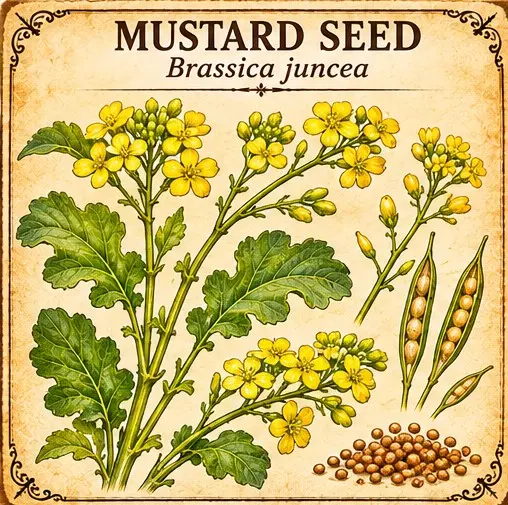
Mustard Seed
Brassica juncea
Brown mustard, grown worldwide for its pungent seeds, leaves and oil. Its heat comes from allyl isothiocyanate, released when the seeds are crushed and wet.
Safety at a glance
- PregnancyNothing recorded
- BreastfeedingNothing recorded
- MedicinesNothing recorded
- Who should avoid itNothing recorded
- Allergies1 note →
- ToxicityNothing recorded
Tap a box to read the safety notes below. “Nothing recorded” means our sources don't cover it, not that it's safe.
What is Mustard Seed?
- Plant family
- Brassicaceae, the mustard and cabbage family
- Parts used
- The seeds, and also leaves
- Where it grows
- Central and South Asia; grown worldwide
- Genus
- Brassica
- Species
- juncea
Also called
Brown Mustard, Indian Mustard
Traditionally used for
- Spice
- Condiment
- Cooking oil
Traditionally described as
- Seeds rich in sinigrin
Health topics
Where Mustard Seed appears in symptom search, and why. Being listed doesn't mean it's a proven treatment.
- Cancer Research
Lab and animal studies only: listed among many effects, it slowed or killed some cancer cells. Not tested against cancer in people.
Safety
Allergies
Mustard allergy is increasing and can cause severe reactions, including anaphylaxis. Mustard can be hidden in many processed foods.[1]Study
Depends on how it's prepared
Mustard oil is high in erucic acid, which caused fat buildup in heart muscle in rodents. The US FDA doesn't allow mustard oil to be sold for cooking, while India's lipid association recommends it as a heart-healthy oil.[2]Study
What does the research say?
Traditional use
These are traditional uses, not proven treatments.
Brown mustard is grown worldwide for its seeds, used whole or ground as a spice and condiment, and for its leaves and oil. Its sharp heat comes from sinigrin, which breaks down into allyl isothiocyanate when the seeds are crushed and wet.[3]Study
Mustard oil is one of the most popular cooking oils in South Asia, especially India.[2]Study
Laboratory & animal research
Lab and animal results show what might be worth studying in people. They don't show that the herb has these effects in humans.
Lab and animal studies suggest its compounds may fight bacteria and kill some cancer cells.[3]Study
In short
A growing food allergen; mustard oil is high in erucic acid.
Sources
- [1] A Comprehensive Review on Mustard-Induced Allergy and Implications for Human Health · DOI: 10.1007/s12016-017-8651-2Peer-reviewed study
- [2] Mustard oil and cardiovascular health: Why the controversy? · DOI: 10.1016/j.jacl.2021.11.002Peer-reviewed study
- [3] Comprehensive advances in phytochemical components, bioactive functionality, and processing applications of mustard (Brassica juncea (L.) Czern.): a review · DOI: 10.3389/fnut.2025.1626333Peer-reviewed study
This information is educational and traditional in nature, and is not a substitute for professional medical advice. Unfamiliar word? See what these words mean.